


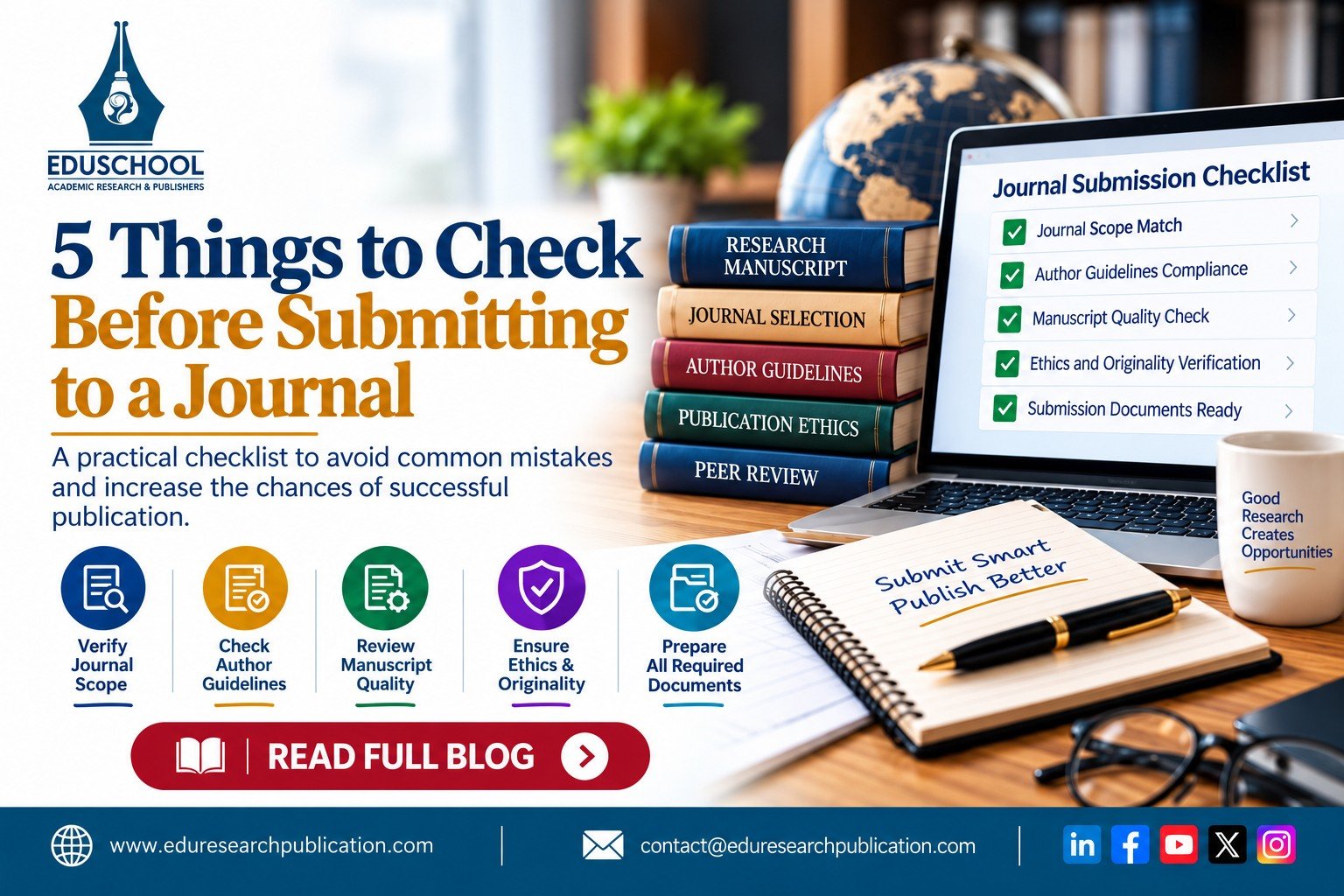
5 Things to Check Before Submitting Your Research Paper to a Journal
Introduction
Publishing a research paper is an important milestone in an academic career. However, writing a good manuscript is only one part of the publication process. Before submitting your work, you must ensure that the journal is suitable, your manuscript meets the required standards, and all ethical and technical requirements are fulfilled.
Many manuscripts face desk rejection or unnecessary delays because of journal-scope mismatch, poor formatting, incomplete submission documents, or inadequate attention to publication ethics.
For PhD scholars, faculty members, research scholars, and early-career researchers, a systematic pre-submission review can help avoid common mistakes.
In this article, Eduschool Academic Research & Publishers presents five essential checks every researcher should complete before submitting a manuscript.
1. Verify the Journal’s Aims and Scope
The first step is to confirm that your research paper matches the journal’s subject area and readership.
Every academic journal has an aims-and-scope statement explaining the topics, methodologies, and contributions it considers suitable for publication.
Before submitting, ask yourself:
- Does the journal publish research in my discipline?
- Does it accept my type of research or article?
- Have similar studies appeared in recent issues?
- Will the journal’s readers find my findings relevant?
- Does my paper contribute to the journal’s stated objectives?
For example, a study on artificial intelligence in higher education may be suitable for an educational technology journal, whereas a study focused primarily on machine-learning algorithms may be better suited to a computer science journal.
Practical tip: Read the aims and scope, examine several recent articles, and explain in your cover letter why your manuscript fits the journal.
2. Verify Indexing and Journal Credibility
Do not choose a journal based only on its website, promotional emails, or claims of high impact.
If indexing is important for your academic objectives, verify it independently through the official database.
For example:
- Scopus: Search the official Scopus Sources database.
- Web of Science: Check the Clarivate Master Journal List.
- DOAJ: Consult the Directory of Open Access Journals for relevant open-access journals.
Check the exact journal title, ISSN/eISSN, publisher, and current coverage status. Remember that indexing in one database does not automatically mean indexing in another.
Also evaluate the journal’s editorial board, peer-review process, publication ethics, and transparency of fees.
Be cautious about guaranteed acceptance, unverifiable impact factors, misleading indexing claims, and promises of publication without meaningful peer review.
Remember: Verify the journal before submitting your manuscript.
3. Review Manuscript Quality and Author Guidelines
A manuscript may contain valuable research but still be returned if it fails to meet the journal’s submission requirements.
Read the author guidelines carefully and check the following:
Title and abstract: Is the title clear, specific, and accurate? Does the abstract summarize the research problem, methodology, key findings, and contribution?
Introduction: Is the research problem clearly explained? Does the introduction establish the significance of the study?
Literature review: Does it critically synthesize relevant research, identify contradictions, and establish a defensible research gap?
Methodology: Are the research design, sampling, data collection, and analytical methods clearly explained?
Results and discussion: Are findings presented accurately and interpreted in relation to the research questions and previous studies?
Conclusion: Does it explain the contribution, implications, limitations, and appropriate directions for future research?
References: Are citations accurate, complete, and formatted according to the journal’s required style?
Finally, check word limits, tables, figures, supplementary files, headings, and formatting.
Practical tip: Use the journal’s own submission checklist rather than relying only on a general research-paper template.
4. Ensure Publication Ethics and Originality
Research integrity is fundamental to responsible academic publishing.
Before submission, confirm that your manuscript complies with the journal’s ethical requirements.
Important checks include:
- Originality: Ensure that the manuscript represents original scholarly work.
- Plagiarism: Check for unattributed copying and inappropriate text reuse.
- Duplicate submission: Do not submit the same manuscript to multiple journals simultaneously unless their policies explicitly permit it.
- Authorship: Ensure that all listed authors meet appropriate authorship criteria and approve the submitted version.
- Research ethics: Include ethics approval, informed consent, or other relevant declarations where applicable.
- Conflicts of interest: Disclose relevant financial or professional relationships.
- Funding: Acknowledge funding sources accurately.
- Data integrity: Ensure that data, images, tables, and reported findings are presented honestly.
If you use generative AI tools, follow the journal’s disclosure and authorship policies. Researchers remain responsible for the accuracy, originality, citations, and integrity of their submissions.
Never fabricate references, manipulate research findings, or rely on an originality percentage as proof that a manuscript is ethically sound.
5. Prepare All Required Submission Documents
A complete submission package can help prevent avoidable administrative delays.
Depending on the journal, you may need:
- A cover letter
- A title page with author details
- A blinded manuscript for double-blind peer review
- An abstract and keywords
- Figures and tables in the required formats
- Ethics approval or consent statements, where applicable
- Funding and conflict-of-interest declarations
- Author contribution statements
- Data availability statements
- Supplementary materials
- Copyright or licence forms, when requested
The cover letter should briefly explain the research problem, the study’s contribution, and why the manuscript is suitable for the journal.
Check whether the journal requires author names and affiliations to be removed from the main manuscript for anonymous review.
Before clicking Submit, review every field in the online submission system and confirm that uploaded files are correct and complete.
A Practical Pre-Submission Checklist
Use this checklist before submitting your next research paper.
- Journal aims and scope match my manuscript
- Journal identity and required indexing verified
- Manuscript follows author guidelines
- Abstract, methods, results and references checked
- Originality and publication ethics reviewed
- All authors have approved the final manuscript
- Required declarations and submission files prepared
- Cover letter and online submission details checked
Common Mistakes to Avoid
Before submitting, make sure you do not:
- Select a journal solely because it claims to be Q1.
- Ignore the journal’s scope and readership.
- Trust indexing claims without official verification.
- Submit a manuscript with incomplete references or declarations.
- Overlook publication fees and copyright conditions.
- Ignore the journal’s peer-review and ethical policies.
- Submit without checking every required document.
- Assume that following the checklist guarantees acceptance.
A pre-submission checklist reduces avoidable errors, but acceptance ultimately depends on the manuscript’s quality, originality, relevance, and the journal’s editorial evaluation.
Conclusion
Successful academic publishing begins before the manuscript reaches the editor.
By checking the journal’s scope, verifying indexing, reviewing manuscript quality, ensuring ethical compliance, and preparing all required documents, researchers can make more informed submission decisions and avoid many preventable delays.
The goal is not simply to submit a paper quickly. It is to submit the right paper to the right journal, in the right format, with the right ethical standards.
At Eduschool Academic Research & Publishers, we encourage PhD scholars, faculty members, and researchers to approach publication strategically and responsibly.
Submit smart. Publish responsibly. Contribute meaningfully to research.
Frequently Asked Questions
1. What should I check first before submitting a research paper?
Start by confirming that the journal’s aims and scope match your manuscript and intended audience.
2. How do I check whether a journal is indexed in Scopus?
Search the exact journal title or ISSN in the official Scopus Sources database and verify its current coverage.
3. Can a good research paper be rejected because of formatting?
Yes. Formatting or missing submission requirements can result in administrative return or delays, although editorial decisions also depend on relevance and research quality.
4. Should I check plagiarism before submission?
Yes. Review your citations and text carefully, and use appropriate similarity-checking tools where available. Similarity percentages require interpretation and are not, by themselves, proof of plagiarism or originality.
5. Does completing all five checks guarantee publication?
No. These checks help improve submission readiness but cannot guarantee acceptance, which depends on editorial assessment and peer review.
