


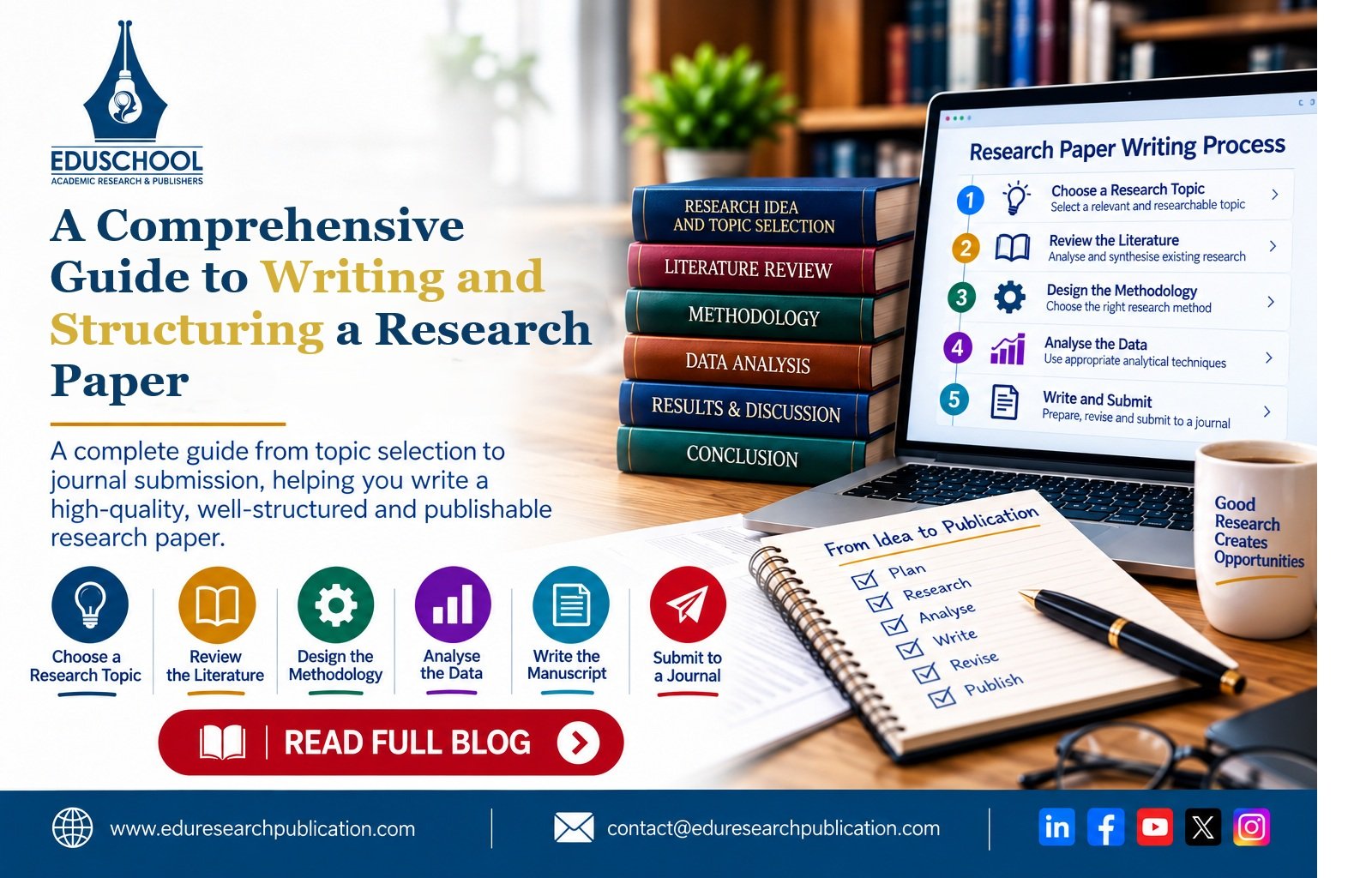
A Comprehensive Guide to Writing and Structuring a Research Paper
Introduction
Writing a research paper is an essential academic skill for PhD scholars, postgraduate students, faculty members, and researchers. A well-written research paper does more than present information. It identifies a meaningful research problem, examines existing knowledge, applies an appropriate methodology, analyses evidence, and contributes to the advancement of knowledge.
However, many researchers struggle to transform their research ideas into a clear, systematic, and publishable manuscript. Common challenges include selecting a research topic, identifying a research gap, reviewing literature, designing the methodology, analysing data, and presenting findings logically.
The good news is that research paper writing becomes more manageable when approached systematically.
A successful research paper follows a logical process: identify the problem, examine the literature, design the study, collect and analyse evidence, interpret the findings, and communicate the contribution clearly.
This step-by-step guide explains how to write a research paper from the initial idea to final journal submission.
Step 1: Choose a Clear and Researchable Topic
The first step is selecting a topic that is relevant, specific, and feasible to investigate.
A broad topic may be interesting but difficult to study within the available time and resources.
For example:
- Broad topic: Artificial Intelligence in Education
- More focused topic: Artificial Intelligence and Student Engagement in Higher Education
- More researchable topic: The Relationship Between AI-Assisted Learning and Student Engagement Among Undergraduate Students in Selected Universities
A good research topic should satisfy three conditions:
- Relevance: It addresses an important academic or practical issue.
- Researchability: Appropriate data, literature, or evidence can be obtained.
- Contribution: The study has the potential to improve understanding or provide useful evidence.
Before finalizing your topic, consider your interests, available resources, research expertise, ethical requirements, and the expectations of your target journal.
Step 2: Identify the Research Problem
A research problem explains what needs to be investigated and why it matters.
Do not begin by collecting large numbers of references without first clarifying the problem you want to solve.
Ask yourself:
- What issue am I investigating?
- Why is this issue important?
- Who is affected by it?
- What is already known?
- What remains uncertain?
- What evidence would help address the problem?
Your research problem should be specific enough to guide the study and significant enough to justify the investigation.
Practical tip: Write a short problem statement before developing your research objectives. This helps keep the entire paper focused.
Step 3: Conduct a Critical Literature Review
A literature review examines and synthesizes relevant previous research.
Its purpose is not simply to list what other researchers have published. It should explain the development of the topic, identify major findings, evaluate disagreements, and establish the foundation for your study.
Search relevant scholarly sources using databases such as Scopus, Web of Science, PubMed, ERIC, or other subject-specific platforms where appropriate.
While reviewing the literature, examine:
- Major concepts and theories
- Important foundational studies
- Recent empirical findings
- Research methods used previously
- Contradictory findings
- Limitations in existing evidence
- Unanswered research questions
Organize your notes using a literature matrix containing authors, year, objectives, methodology, findings, limitations, and possible research gaps.
Golden rule: Summarize less, compare more, and critically synthesize the evidence.
Step 4: Identify the Research Gap
The research gap explains what remains insufficiently understood or unresolved in the existing literature.
Common types include:
- Theoretical gaps
- Empirical gaps
- Methodological gaps
- Contextual gaps
- Population gaps
- Measurement gaps
- Contradictory findings
For example, previous studies may report inconsistent relationships between AI-assisted learning and student engagement. Your study might investigate whether instructional support or technological confidence helps explain those differences.
A strong research gap must be supported by evidence from the literature.
Avoid claiming that a topic has never been studied unless your search supports that conclusion.
A meaningful research gap explains not only what is missing but also why addressing it matters.
Step 5: Formulate Research Objectives and Questions
Research objectives describe what the study intends to achieve. Research questions specify what the investigation seeks to answer.
Example:
Research objective: To examine the relationship between AI-assisted learning and student engagement among undergraduate students.
Research question: What is the relationship between AI-assisted learning and student engagement among undergraduate students?
Depending on the research design, you may also formulate hypotheses.
For example:
H1: AI-assisted learning is positively associated with student engagement.
This is an illustrative hypothesis; the direction and wording must be justified by the relevant theory and evidence.
Ensure that your research problem, objectives, questions, hypotheses, and methodology are logically aligned.
Step 6: Develop the Research Methodology
The methodology explains how the research was conducted and why the chosen approach is appropriate.
Depending on your research question, you may use quantitative, qualitative, or mixed-methods research.
Quantitative research
Uses numerical data and statistical methods to examine patterns, relationships, differences, or effects.
Examples include surveys, experiments, and structured observational studies.
Qualitative research
Explores experiences, meanings, perceptions, and processes through methods such as interviews, focus groups, document analysis, and observation.
Mixed-methods research
Integrates quantitative and qualitative evidence to address complementary aspects of a research problem.
Your methodology should explain:
- Research design
- Study setting and population
- Sampling strategy and sample-size justification
- Data collection procedures
- Measurement instruments or interview protocols
- Data analysis techniques
- Validity, reliability, or trustworthiness, as appropriate
- Ethical approval and informed consent, where applicable
Choose the method that best answers your research question—not simply the method that is easiest or most familiar.
Step 7: Collect Reliable Data
The quality of a research paper depends heavily on the credibility of its evidence.
Data may come from surveys, experiments, interviews, observations, archival records, publicly available datasets, or other appropriate sources.
Before collecting data, ensure that your instruments and procedures are suitable for the study.
Consider:
- Accuracy and completeness
- Sampling bias
- Measurement quality
- Data security and confidentiality
- Informed consent, where applicable
- Appropriate ethical approvals
- Documentation of data collection
Never fabricate, manipulate, or selectively alter data to support a preferred conclusion.
If your paper is a conceptual study or a literature review, explain the sources and procedures used to develop your analysis instead of presenting it as original empirical data collection.
Step 8: Analyse the Data
Data analysis transforms raw information into findings that address your research objectives.
For quantitative research, the analysis may include descriptive statistics, hypothesis testing, regression, or other suitable techniques.
For qualitative research, it may include thematic analysis, content analysis, or another justified interpretive approach.
The method must fit the data, research question, and assumptions of the chosen analytical technique.
Report your results accurately. Include appropriate estimates, uncertainty measures, tables, figures, or qualitative evidence as required.
Do not select statistical tests merely because they appear sophisticated. Complex analysis cannot compensate for poor sampling, inappropriate measurement, or an unsuitable research design.
Step 9: Write the Results and Discussion
Although closely related, the results and discussion sections serve different purposes.
Results
Present what the analysis revealed.
Report the findings clearly, including unexpected or statistically nonsignificant results where relevant.
Avoid overstating the importance of individual results.
Discussion
Explain what the findings mean.
Compare them with previous research, consider alternative interpretations, discuss theoretical or practical implications, and explain how the findings address the research problem.
For example, if your results differ from previous studies, explore possible explanations such as differences in context, sample characteristics, measurement, or methodology.
The results tell readers what you found; the discussion explains why the findings matter.
Step 10: Write the Conclusion
The conclusion should bring the paper’s argument together.
A strong conclusion generally includes:
- A concise answer to the research question
- The main findings
- The study’s contribution
- Relevant theoretical or practical implications
- Important limitations
- Suggestions for future research
Do not introduce major new evidence or make claims that exceed what your results support.
Limitations should be acknowledged honestly. Explaining limitations does not weaken a credible study; it helps readers interpret the evidence appropriately.
Step 11: Prepare the Title, Abstract, and Keywords
Although these appear near the beginning of a paper, they are often easier to finalize after the study is complete.
Title
Use a concise, informative title that reflects the main topic, variables, population, or context where appropriate.
Avoid vague wording and unnecessary abbreviations.
Abstract
Depending on the journal’s requirements, summarize:
- Background or research problem
- Research objective
- Methodology
- Principal findings
- Main contribution or implication
Follow the journal’s word limit and abstract format.
Keywords
Select relevant terms that accurately represent the subject, concepts, methods, and context of your study. These help readers discover your work.
Step 12: Follow the Research Paper Structure
Many empirical research papers follow the IMRaD structure:
- Introduction
- Methods
- Results
- Discussion
A complete manuscript may also include a title, abstract, keywords, literature review or theoretical background, conclusion, references, acknowledgements, and declarations.
The exact structure varies by discipline and article type. Review the target journal’s author guidelines before organizing your manuscript.
Step 13: Ensure Citation Accuracy and Research Ethics
Responsible research writing requires accurate attribution and transparent reporting.
Before submission:
- Verify that every citation supports the claim it accompanies.
- Check that all cited works appear in the reference list.
- Follow the required referencing style.
- Avoid plagiarism and inappropriate text reuse.
- Ensure authorship is accurate and approved by all authors.
- Disclose funding and relevant conflicts of interest.
- Provide ethics, consent, and data availability statements where required.
- Follow the journal’s policies concerning generative AI tools.
Never invent references or rely on unverified citations generated by software or AI systems.
Step 14: Edit and Review the Manuscript
A first draft is rarely ready for submission.
Review the manuscript for:
Scientific quality: Does the evidence support the conclusions?
Logical flow: Does each section contribute to the central argument?
Consistency: Do the objectives, methods, results, and conclusions align?
Clarity: Can readers understand the reasoning without unnecessary complexity?
Technical accuracy: Are equations, tables, figures, and references correct?
Journal compliance: Does the manuscript meet the target journal’s requirements?
Where possible, seek constructive feedback from a supervisor, co-author, or knowledgeable colleague before submission.
Step 15: Select the Right Journal and Submit
Journal selection should be based on research fit and credibility—not prestige alone.
Before submitting, evaluate:
- Aims and scope
- Recent relevant publications
- Peer-review practices
- Editorial standards
- Current indexing status, if required
- Journal metrics, where relevant
- Publication fees and access model
- Author guidelines and submission requirements
Verify indexing through the official database rather than relying only on promotional claims.
Prepare the cover letter and all required submission documents. Submit to one journal at a time unless the applicable policies explicitly allow otherwise.
After submission, respond to reviewer comments professionally, address each point carefully, and explain any justified disagreement with evidence.
A Practical Research Paper Writing Checklist
Use this checklist to assess your manuscript before submission.
- Research topic is focused and researchable
- Research problem and gap are clearly justified
- Literature is critically synthesized
- Objectives and questions are aligned
- Methodology is appropriate and transparent
- Data and analysis are credible
- Results are accurately reported
- Discussion explains the contribution
- Conclusion follows from the evidence
- Citations, ethics and journal requirements are checked
Common Mistakes to Avoid
Researchers should avoid these frequent problems:
- Selecting a topic without identifying a meaningful problem.
- Writing a descriptive literature review without critical synthesis.
- Claiming a research gap without sufficient evidence.
- Using a methodology that does not answer the research question.
- Applying statistical methods without checking their suitability.
- Reporting only favourable results.
- Drawing conclusions beyond the evidence.
- Ignoring research ethics or citation accuracy.
- Submitting without following author guidelines.
- Choosing a journal based only on its ranking or indexing claims.
Avoiding these mistakes does not guarantee publication, but it improves the coherence, transparency, and credibility of a research manuscript.
Conclusion
Writing a research paper is a systematic process that requires clear thinking, critical reading, appropriate methodology, credible evidence, and responsible communication.
A strong paper begins with a meaningful research problem and develops a logical argument supported by reliable evidence. Every section—from the introduction to the conclusion—should contribute to answering the research question and explaining the study’s contribution.
The golden rule of research writing is simple: Identify a meaningful problem, use a defensible method, report the evidence honestly, and explain what your research contributes to knowledge.
At Eduschool Academic Research & Publishers, we encourage PhD scholars, postgraduate students, faculty members, and researchers to develop rigorous, transparent, and ethical research-writing practices.
Frequently Asked Questions
1. What is the first step in writing a research paper?
Choose a focused, researchable topic and clearly define the problem you intend to investigate.
2. How many pages should a research paper contain?
There is no universal page requirement. Length depends on the discipline, study design, article type, and target journal’s guidelines.
3. Can I write a research paper without collecting primary data?
Yes. Depending on the research question, you may conduct a systematic review, bibliometric analysis, conceptual study, secondary-data analysis, or other appropriate research.
4. How do I identify a research gap?
Critically examine previous studies, compare their findings and methods, identify unresolved questions, and explain why addressing them matters.
5. Does following all the steps guarantee publication?
No. Publication depends on originality, research quality, methodological rigour, relevance, journal suitability, and editorial evaluation
