


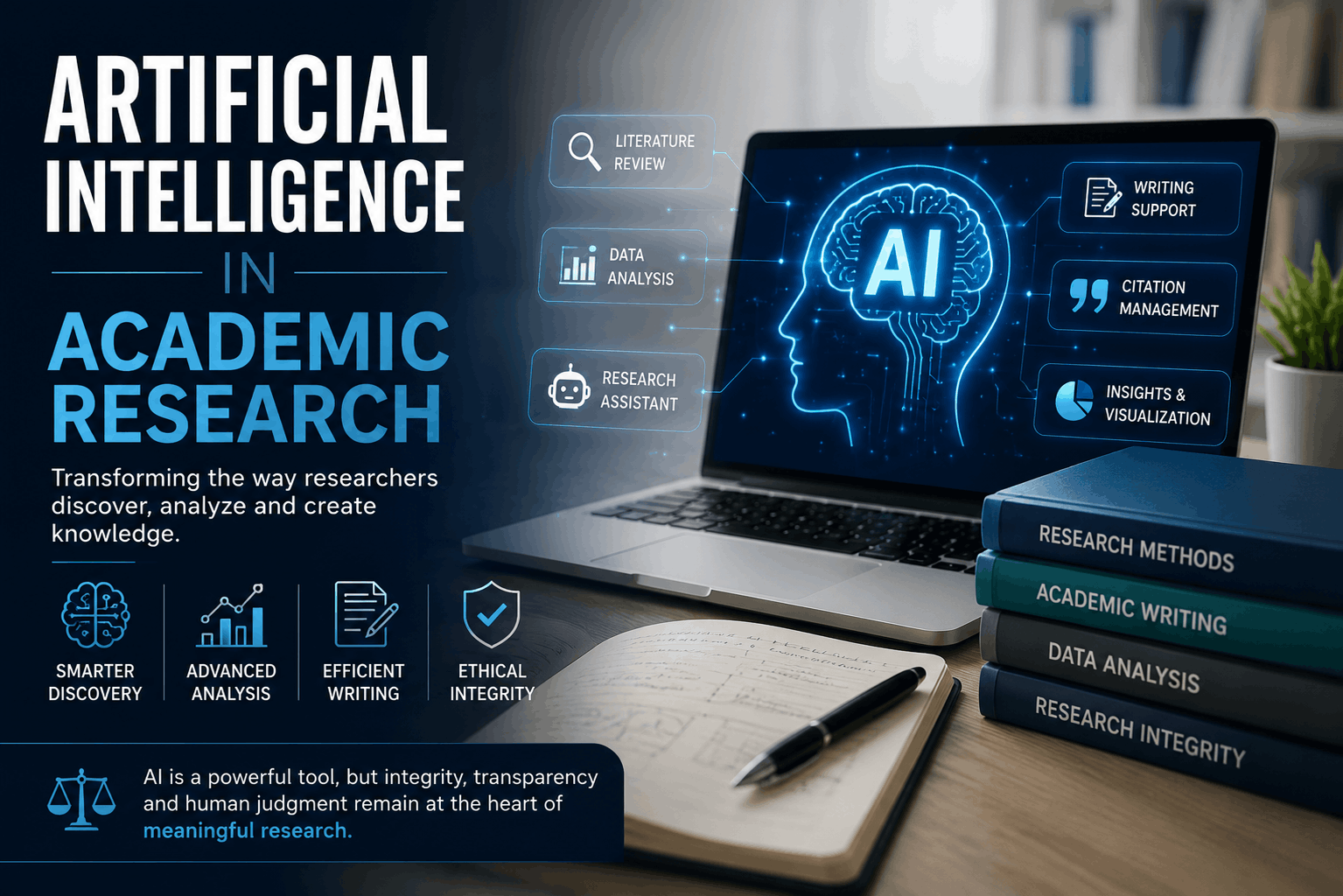
ARTIFICIAL INTELLIGENCE IN ACADEMIC RESEARCH
In our previous blog, "Why Research Integrity Matters", we explored how honesty and accountability shape credible scholarship. Today, that same conversation has expanded to include a powerful new player — artificial intelligence. The role of artificial intelligence in academic research is growing rapidly, transforming how scholars search, write, analyze, and communicate. But while AI brings impressive efficiency, it also raises serious questions about authorship, transparency, and academic integrity. Here's a balanced look at both sides.
1. AI is Reshaping Academic Research From literature reviews to data analysis and manuscript drafting, AI tools are now part of nearly every stage of the research process. Tools like ChatGPT, Claude, Elicit, Scite, and ResearchRabbit help researchers work faster and explore ideas more efficiently. This shift represents the biggest change in academic workflows since the arrival of the internet.
2. Accelerating Literature Review AI tools can scan thousands of papers, summarize key findings, and identify research gaps in minutes. This dramatically reduces the time required for systematic reviews, scoping studies, and background research. However, AI-generated summaries should always be cross-verified with the original sources before being cited in your work.
3. AI in Data Analysis and Pattern Recognition Machine learning models excel at analyzing large datasets, detecting patterns, and forecasting trends across disciplines. Researchers in genomics, climate science, social sciences, and engineering increasingly rely on AI to extract insights that would be impossible manually. Properly applied, AI-assisted analysis enhances both the depth and scale of academic work.
4. AI for Academic Writing and Editing AI writing assistants help researchers draft outlines, polish grammar, restructure sentences, and improve clarity. They are particularly useful for non-native English speakers and early-career academics still developing their writing voice. The key is to treat AI as an editor, not a ghostwriter — your ideas and arguments must remain your own.
5. AI for Translation and Cross-Language Research AI-powered translation tools make it easier to access research published in different languages. This is opening up regional scholarship, especially for Indian researchers working across English, Hindi, and other Indian languages. However, technical and contextual accuracy should always be verified by a human reviewer familiar with the field.
6. Why AI Cannot Be an Author Major international bodies — including COPE, ICMJE, and WAME — agree that AI tools cannot be listed as authors. Authorship requires accountability, the ability to approve a manuscript, and responsibility for its accuracy, which AI cannot provide. Most leading publishers, including Elsevier, Wiley, Springer Nature, and the Nature Portfolio, have formalized this position in their policies.
7. Disclosing AI Use Transparently Ethical AI use requires clear disclosure of how, where, and why AI tools were used in your research or writing. Most journals now ask authors to specify the AI tool, version, and purpose in the Methods or Acknowledgements section. Disclosure protects credibility and aligns your work with the latest publishing standards.
8. Watch Out for Hallucinated Citations AI tools sometimes generate fake or inaccurate references — a phenomenon known as "hallucination." Submitting AI-generated citations without verification can lead to embarrassing retractions and serious integrity concerns. Always confirm each reference by checking the original source directly.
9. Protect Data Privacy When Using AI Uploading unpublished research, patient data, or confidential information to AI tools raises serious privacy and intellectual property risks. Many tools store inputs to train future models, making sensitive material potentially exposed. Use institution-approved AI platforms wherever possible and avoid sharing sensitive datasets with public AI services.
10. The Indian Regulatory Perspective In India, AICTE has explicitly required disclosure of AI use in academic work, and UGC-aligned universities increasingly treat undisclosed AI text as plagiarism. Recent PhD thesis rejections at Indian universities for AI copy-paste show that enforcement is no longer theoretical. Researchers should stay informed about both national guidelines and individual journal policies before submitting AI-assisted work.
Final Thoughts Used responsibly, artificial intelligence in academic research is a powerful collaborator — accelerating discovery, improving communication, and expanding access to knowledge. Used carelessly, it can compromise originality, accuracy, and trust. Stay transparent, verify everything AI produces, follow your journal's disclosure rules, and treat AI as an assistant to your scholarship, never a substitute for your thinking.
Ready to publish your research in an International Peer-Reviewed Journal?
Submit your manuscript today and gain global academic visibility
