


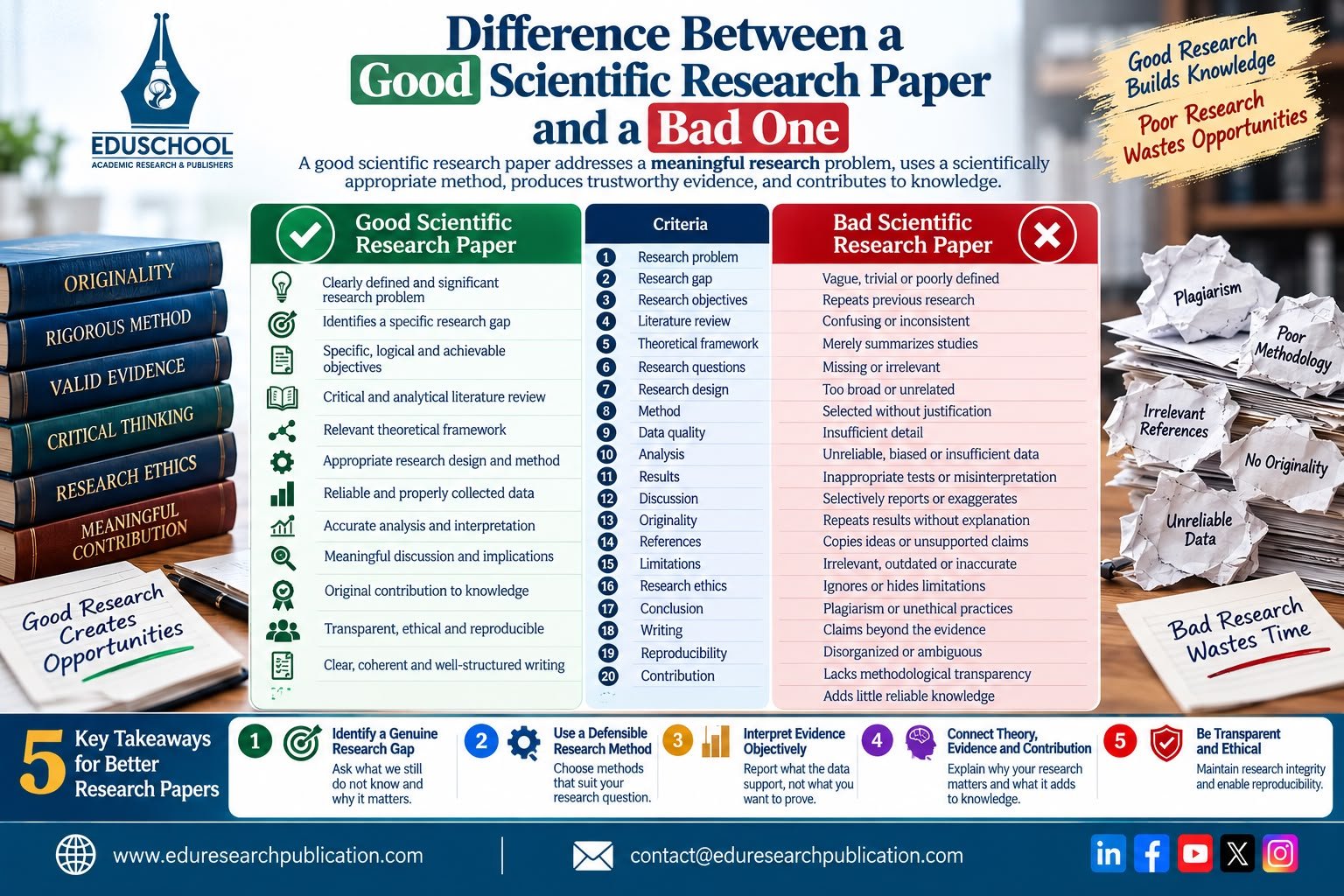
Difference Between a Good and Bad Scientific Research Paper
A good scientific research paper does more than present information. It addresses a meaningful research problem, uses a scientifically appropriate method, produces trustworthy evidence, and contributes something valuable to existing knowledge.
A bad research paper may contain many pages, numerous references, and sophisticated terminology, yet fail to provide reliable evidence or a meaningful contribution.
1. Key differences at a glance
Criteria | Good scientific research paper | Bad scientific research paper |
Research problem | Clearly defined and significant | Vague, trivial, or poorly defined |
Research gap | Identifies a specific gap in existing knowledge | Repeats previous research without justification |
Research objectives | Specific, logical, and achievable | Confusing or inconsistent |
Literature review | Critically evaluates previous studies | Merely summarizes one study after another |
Theoretical framework | Connects theory with the research problem | Missing, irrelevant, or superficial |
Research questions | Focused and answerable | Too broad or unrelated to the objectives |
Research design | Appropriate for the research question | Selected without sufficient justification |
Method | Clearly explains how evidence was obtained and analyzed | Insufficient detail to evaluate or reproduce the study |
Data quality | Uses relevant, credible, and properly collected data | Uses unreliable, biased, or insufficient data |
Analysis | Applies appropriate analytical techniques | Uses inappropriate tests or misinterprets results |
Results | Reports findings accurately | Selectively reports or exaggerates findings |
Discussion | Explains meaning, implications, and alternative interpretations | Repeats results without explaining them |
Originality | Offers a defensible contribution to knowledge | Copies ideas or makes unsupported novelty claims |
References | Relevant, accurate, and properly cited | Irrelevant, outdated, inaccurate, or missing citations |
Limitations | Acknowledges weaknesses and uncertainty | Hides limitations or claims too much |
Research ethics | Maintains integrity and appropriate approvals | Involves plagiarism, fabricated data, or unethical practices |
Conclusion | Follows logically from the evidence | Makes claims beyond what the data support |
Writing | Clear, coherent, and logically structured | Disorganized, ambiguous, or unnecessarily complicated |
Reproducibility | Provides sufficient methodological transparency | Prevents readers from evaluating or repeating the study |
Contribution | Advances understanding or provides useful evidence | Adds little reliable knowledge |
2. The five fundamental differences
2.1. A good paper identifies a genuine research gap
A good researcher asks: What do we still not know, and why does it matter?
A weak researcher often asks only: What topic can I write about?
Example: Instead of studying employee satisfaction once again without justification, investigate an important unanswered question about how hybrid work affects employee retention in a specific context.
2.2. A good paper uses a defensible research method
A good study selects its method according to the research question, explains the sampling or experimental procedure, and justifies its analytical choices.
A weak study chooses methods merely because they are easy or popular.
Remember: A sophisticated statistical technique cannot compensate for poor research design or unreliable data.
2.3. A good paper interprets evidence rather than forcing a conclusion
A good researcher reports what the evidence actually supports, including unexpected or statistically nonsignificant results.
A weak researcher selectively reports favourable findings, confuses correlation with causation, or exaggerates statistical significance.
2.4. A good paper connects theory, evidence, and contribution
A strong paper explains why the research matters, how its theoretical framework guides the investigation, and what its findings add to existing knowledge.
A weak paper treats the literature review, theoretical framework, methodology, results, and conclusion as disconnected sections.
2.5. A good paper is transparent and ethically sound
Readers should be able to assess how the research was conducted, whether the conclusions are justified, and what limitations remain.
Fabricated data, plagiarism, manipulated images, undisclosed conflicts of interest, and misleading reporting undermine scientific credibility.
3. A practical example
Consider a research topic: The Impact of Social Media on Academic Performance.
Weak research approach
- Collect responses from 30 conveniently selected students without explaining the sample size.
- Ask general questions about social media use.
- Present percentages without connecting them to a clear research question.
- Conclude that social media reduces academic performance without evidence establishing causation.
Stronger research approach
- Identify a specific research gap using a critical review of previous studies.
- Define social media use and academic performance operationally.
- Formulate clear research questions and, where appropriate, testable hypotheses.
- Justify the sample, study design, measures, and analytical methods.
- Report the findings, uncertainty, limitations, and alternative explanations.
- Draw conclusions that match the evidence and clearly explain the contribution.
Notice that the stronger paper is not necessarily the one with the largest sample, the most complex statistics, or the most positive results. It is the one whose design and evidence appropriately answer its research question.
4. What separates a publishable paper from a potentially high-impact paper?
A paper can be technically sound and publishable without being highly influential. Stronger papers generally combine several qualities:
- Scientific rigour: The evidence and methods withstand critical examination.
- Originality: The work adds a meaningful insight, finding, method, or theoretical development.
- Theoretical significance: The study advances, tests, or refines relevant theory where appropriate.
- Methodological transparency: Other researchers can understand and evaluate the research process.
- Broad relevance: The findings matter to the journal’s intended readership.
- Clear scholarly communication: The argument progresses logically from the research problem to the contribution.
For Q1 journal submissions, these qualities can be especially important, but Q1 status alone does not guarantee acceptance, and not every excellent paper must use a theoretical framework or quantitative hypothesis testing. The appropriate expectations depend on the discipline, article type, and journal.
5. The Eduschool research quality test
Before submitting a manuscript, ask these ten questions.
Manuscript self-assessment
- Is the research problem clearly defined and important?
- Is the research gap supported by a critical literature review?
- Are the objectives and research questions aligned?
- Is the theoretical or conceptual framework justified, where appropriate?
- Is the research design suitable for answering the research question?
- Are the data collection and analysis methods defensible?
- Are the results reported accurately and transparently?
- Does the discussion explain the contribution beyond repeating results?
- Are limitations, ethics, and references handled properly?
- Do the conclusions follow directly from the evidence?
Final message for researchers: A good scientific research paper is not defined by its length, number of references, statistical complexity, or journal ranking. It is defined by the quality of the research question, the credibility of the evidence, the rigour of the methods, the integrity of the reporting, and the significance of its contribution to knowledge.
For Eduschool Academic Research and Publishers, this is a valuable principle to communicate to every PhD scholar and aspiring journal author.
