


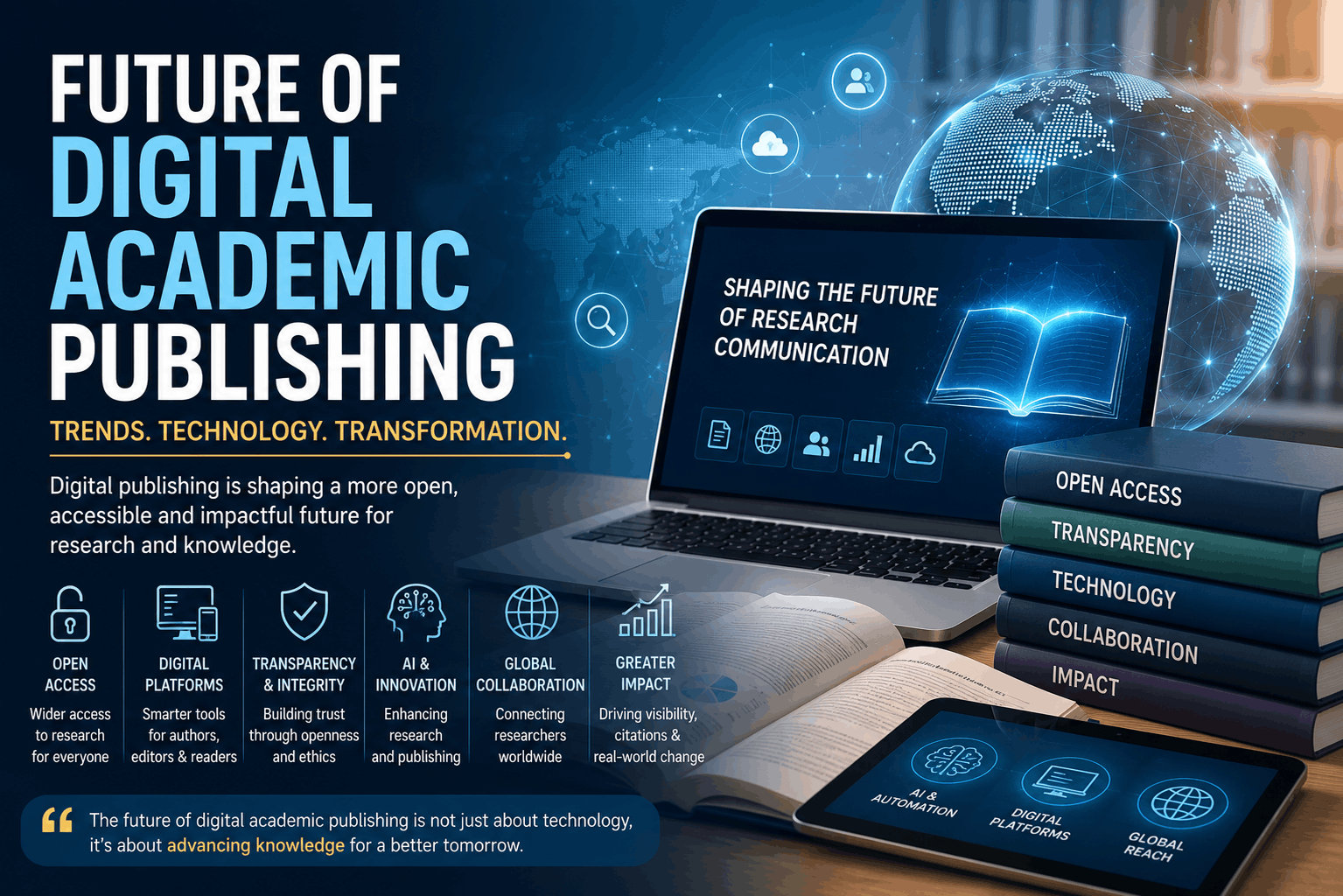
FUTURE OF DIGITAL ACADEMIC PUBLISHING
In our previous blog, "Artificial Intelligence in Academic Research", we explored how AI is reshaping the work of researchers. But AI is just one of many forces transforming the wider publishing landscape. The future of digital academic publishing is being defined by openness, accessibility, transparency, and technology working together to make research faster, fairer, and more impactful. Here's a look at the most important trends every researcher and institution should understand.
1. The Digital Transformation of Academic Publishing Academic publishing has moved decisively away from print-first workflows into a fully digital ecosystem. Submissions, peer review, editing, indexing, and reader access now happen almost entirely online. This shift has dramatically accelerated publication timelines while expanding the global reach of every paper.
2. The Rise of Open Access Open Access (OA) publishing is rapidly becoming the new normal. Initiatives like Plan S, Diamond Open Access models, and funder mandates from major agencies are pushing more research behind no paywalls. For researchers, OA means greater visibility and citations; for readers, it means knowledge without subscription barriers.
3. India's One Nation One Subscription (ONOS) Initiative Launched on January 1, 2025, ONOS is one of the world's largest centralized journal access programs. With a ₹6,000 crore allocation across 2025–2027, it provides nearly 1.8 crore students, faculty, and researchers in over 6,300 government institutions access to roughly 13,000 journals from 30 publishers. Coordinated by INFLIBNET, ONOS also funds Article Processing Charges (APCs) for selected high-quality publications, marking a major shift in India's research access landscape.
4. Preprints and Real-Time Knowledge Sharing Preprint servers like arXiv, bioRxiv, medRxiv, and SSRN allow researchers to share findings even before formal peer review. This accelerates scientific dialogue and gives authors early visibility and feedback. Many journals now openly welcome preprint submissions, recognizing preprints as a legitimate part of the publishing pipeline.
5. AI-Driven Editorial and Discovery Workflows Publishers are increasingly using AI to streamline manuscript screening, plagiarism detection, statistical checks, and reviewer matching. AI-powered discovery tools like Semantic Scholar, Scite, and Elicit are also transforming how researchers find and evaluate literature. Used responsibly, AI is making publishing faster while maintaining quality standards.
6. Open and Transparent Peer Review Many journals now experiment with open peer review, where reviewer identities and reports are published alongside the article. This trend toward transparency reduces bias, increases accountability, and gives readers more context. Transparent peer review is gradually replacing the traditional single-blind model in several disciplines.
7. Data Sharing and Reproducibility Sharing datasets, code, and methods is becoming an expectation rather than an option. Many journals now require authors to deposit raw data in repositories aligned with the FAIR principles — Findable, Accessible, Interoperable, and Reusable. Reproducibility is no longer a bonus feature; it's the new baseline for credible research.
8. Alternative Metrics and Article-Level Evaluation Traditional impact factor scoring is gradually being supplemented by altmetrics — measures based on social media mentions, news coverage, policy citations, and downloads. These metrics provide a richer picture of how research is being received in real time. Article-level evaluation is making each paper's impact more visible, rather than relying solely on the journal's prestige.
9. Multimedia and Interactive Research Articles Static PDFs are slowly giving way to interactive, multimedia-rich articles. Researchers can now embed videos, interactive figures, executable code, and 3D visualizations into their publications. These richer formats make complex research more accessible and engaging across disciplines.
10. Stronger Vigilance Against Predatory Publishing As digital publishing expands, predatory journals have also multiplied — but so have the tools to detect them. Regulators, institutions, and databases like DOAJ, Scopus, and Web of Science have tightened evaluation criteria. Researchers today have far more resources to verify a journal's credibility before submitting their work.
Final Thoughts The future of digital academic publishing belongs to those who embrace openness, transparency, and technology while protecting research integrity. Open access, ONOS, AI-driven workflows, transparent peer review, and richer publication formats are not isolated trends — they are converging to reshape how knowledge is created and shared. Researchers who adapt early to these shifts will not only publish more efficiently but also lead the next era of global scholarship.
Ready to publish your research in an International Peer-Reviewed Journal?
Submit your manuscript today and gain global academic visibility
