


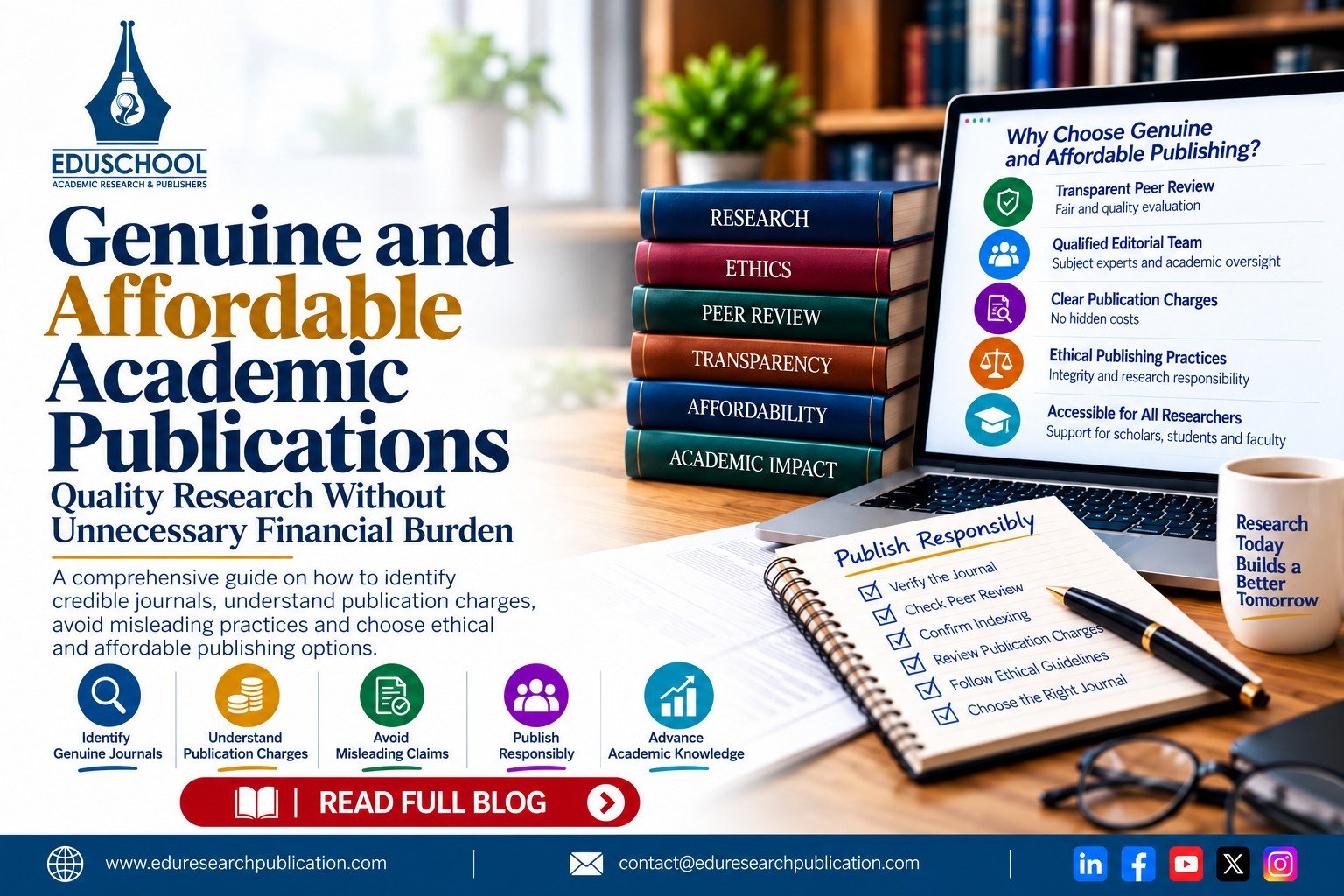
Genuine and Affordable Academic Publications: Quality Research Without Unnecessary Financial Burden
Introduction
Academic publishing plays a vital role in the development and dissemination of knowledge. For research scholars, postgraduate students, doctoral candidates, faculty members, and independent researchers, publishing a research paper is an important step towards sharing discoveries, contributing to academic discussions, and advancing professional development.
However, researchers often face two significant challenges: identifying genuine academic journals and finding publication opportunities that are financially affordable.
Some researchers encounter misleading claims, unclear publication charges, unrealistic acceptance promises, and journals that do not follow proper peer-review procedures. These challenges highlight the need for greater awareness of ethical, transparent, and affordable academic publishing.
At Eduschool Academic Research & Publishers, we believe that genuine research deserves a fair opportunity to reach the academic community without unnecessary financial barriers.
What Is Genuine Academic Publishing?
Genuine academic publishing is a systematic process through which research is evaluated, improved, and disseminated according to established scholarly and ethical standards.
A credible journal should demonstrate the following characteristics:
- Transparent peer review: Manuscripts are evaluated through a clearly explained review process appropriate to the journal’s policies.
- Qualified editorial oversight: Editors and reviewers possess relevant academic or professional expertise.
- Publication ethics: The journal addresses plagiarism, research misconduct, conflicts of interest, corrections, and retractions.
- Clear publication policies: Author guidelines, copyright terms, open-access policies, and publication charges are communicated transparently.
- Verifiable journal information: The publisher provides accurate details about its identity, editorial team, ISSN, indexing status, and publication history.
- Responsible editorial decisions: Acceptance depends on the manuscript’s quality, relevance, originality, and compliance with the journal’s requirements.
Researchers should remember that a professional-looking website or an ISSN alone does not guarantee a journal’s quality or credibility. Journal policies, editorial practices, and indexing claims must be independently verified.
Why Affordable Academic Publishing Matters
Research frequently requires substantial investments of time, effort, and money. Researchers may need to pay for data collection, laboratory work, software, field visits, statistical analysis, and thesis preparation.
When publication charges are excessively high or inadequately explained, researchers may find it difficult to share their work, particularly when institutional funding is unavailable.
Affordable academic publishing can help address this challenge by providing reasonable publication options while maintaining appropriate editorial and ethical standards.
Affordable publishing is especially important for:
- Research scholars and doctoral candidates.
- Postgraduate students developing their research skills.
- Early-career faculty members.
- Independent researchers without institutional funding.
- Academicians working in emerging or interdisciplinary research areas.
- Researchers from institutions with limited publication budgets.
Affordability should make genuine publishing more accessible—not reduce the quality or integrity of the research evaluation process.
Affordable Does Not Mean Low Quality
One common misconception is that a lower publication fee automatically indicates poor quality, while an expensive journal must be superior.
Neither assumption is reliable.
Publication charges may vary because of differences in editorial infrastructure, production requirements, journal funding models, distribution, and access arrangements. A journal’s credibility should be assessed through its actual practices rather than its price alone.
An ethical publisher should aim to maintain a sustainable balance between affordability and quality.
This includes investing in editorial management, appropriate peer review, plagiarism screening where applicable, professional production, metadata accuracy, and long-term publication accessibility.
Researchers should also understand that legitimate journals may charge an article processing charge (APC), while others operate without author fees. Neither model alone establishes credibility.
How to Identify Genuine and Affordable Journals
Before submitting a manuscript, researchers should conduct a careful journal evaluation.
1. Verify the journal’s identity
Check the official journal website, publisher details, ISSN information, editorial board, contact information, and publication history.
2. Examine the peer-review process
Understand how manuscripts are assessed, whether revisions may be required, and how editorial decisions are made. Be cautious of guaranteed acceptance or implausibly short review periods.
3. Check indexing claims independently
If a journal claims to be indexed in Scopus, Web of Science, or another recognised database, verify the journal’s current status directly through the relevant database or official source. Do not rely solely on logos displayed on a website.
4. Review publication charges before submission
Check whether submission fees, APCs, taxes, optional services, or other charges apply. Ask for written clarification if any cost is unclear.
5. Read recent published articles
Assess the relevance, research quality, citation information, writing standards, and consistency of published work.
6. Examine publication ethics and author rights
Look for clear policies covering plagiarism, authorship, research ethics, copyright, corrections, retractions, and complaints.
7. Match the journal to your research
Choose a journal whose aims, scope, readership, and article requirements align with your manuscript. A suitable journal is not necessarily the most expensive or the most widely advertised one.
The Importance of Transparent Publication Charges
Transparency is an essential element of responsible academic publishing.
Researchers should know the applicable charges before making a submission decision. If an APC is required, the publisher should explain the amount, payment stage, included services, and any applicable taxes or additional costs.
Where discounts, waivers, or financial assistance are available, their eligibility conditions should also be communicated clearly.
A transparent publication model allows researchers to plan their budgets, compare legitimate options, and make informed decisions without financial surprises.
At Eduschool Academic Research & Publishers, our publishing philosophy is grounded in the importance of clarity, academic responsibility, and accessible research communication. Authors should always consult the relevant journal’s current author guidelines and fee policy for specific terms.
Avoiding Predatory and Misleading Publication Practices
Researchers should remain alert to warning signs such as:
- Promises of guaranteed publication regardless of manuscript quality.
- Claims of indexing that cannot be independently verified.
- Unclear or unexpectedly disclosed publication charges.
- Editorial board members whose affiliations cannot be confirmed.
- Little evidence of meaningful peer review.
- Misleading claims about impact factors, rankings, or recognition.
- Pressure to pay immediately without clear publication terms.
A low fee does not automatically make a journal predatory, and a high fee does not automatically make it trustworthy. The decision should be based on verifiable evidence of editorial integrity and publishing practices.
Researchers should also distinguish between a journal being registered, having an ISSN, being peer-reviewed, and being indexed in a particular database. These are different characteristics and should never be presented as interchangeable credentials.
Eduschool Academic Research & Publishers: Supporting Responsible Research Communication
Eduschool Academic Research & Publishers recognises that researchers need publishing opportunities that combine academic responsibility, transparent policies, and reasonable costs.
Our objective is to support researchers by encouraging:
- Responsible manuscript submission and evaluation.
- Clear communication between authors and editorial teams.
- Accessible information about publication requirements and applicable fees.
- Respect for research originality and publication ethics.
- Appropriate matching between manuscripts and journal subject areas.
- Continuous improvement in editorial and publishing practices.
We encourage authors to read journal-specific policies carefully, prepare manuscripts according to the prescribed guidelines, and respond constructively to reviewers’ comments.
Publication is not merely the act of placing a paper online. It is a responsibility to the research community, the institutions that support scholarship, and the readers who rely on published findings.
Practical Advice for Researchers
Before selecting a journal, ask yourself five questions:
- Is the journal appropriate for my research topic?
- Can I independently verify its editorial and indexing claims?
- Is its peer-review process clearly explained?
- Are all publication charges disclosed in advance?
- Does the journal demonstrate responsible publishing practices?
If the answers are unclear, take time to investigate before submitting your manuscript or making any payment.
A careful decision today can protect your research, finances, and academic reputation in the future.
Conclusion
Genuine and affordable academic publishing is an important part of building an inclusive, transparent, and responsible research ecosystem.
Researchers should not have to choose between reasonable publication costs and academic integrity. At the same time, affordability must never be used as a justification for weak editorial standards or misleading claims.
The best publication decision is one that considers research quality, journal suitability, ethical practices, transparency, accessibility, and long-term academic value.
Eduschool Academic Research & Publishers encourages researchers to pursue publication with confidence, verify journal credentials carefully, and choose responsible publishing partners.
Let us work together to make scholarly communication more accessible, transparent, and meaningful—while preserving the standards that give academic research its value.
Publish responsibly. Choose transparently. Advance knowledge ethically.
Explore the relevant journal’s aims and scope, author guidelines, peer-review policy, and publication charges before submitting your manuscript.
