


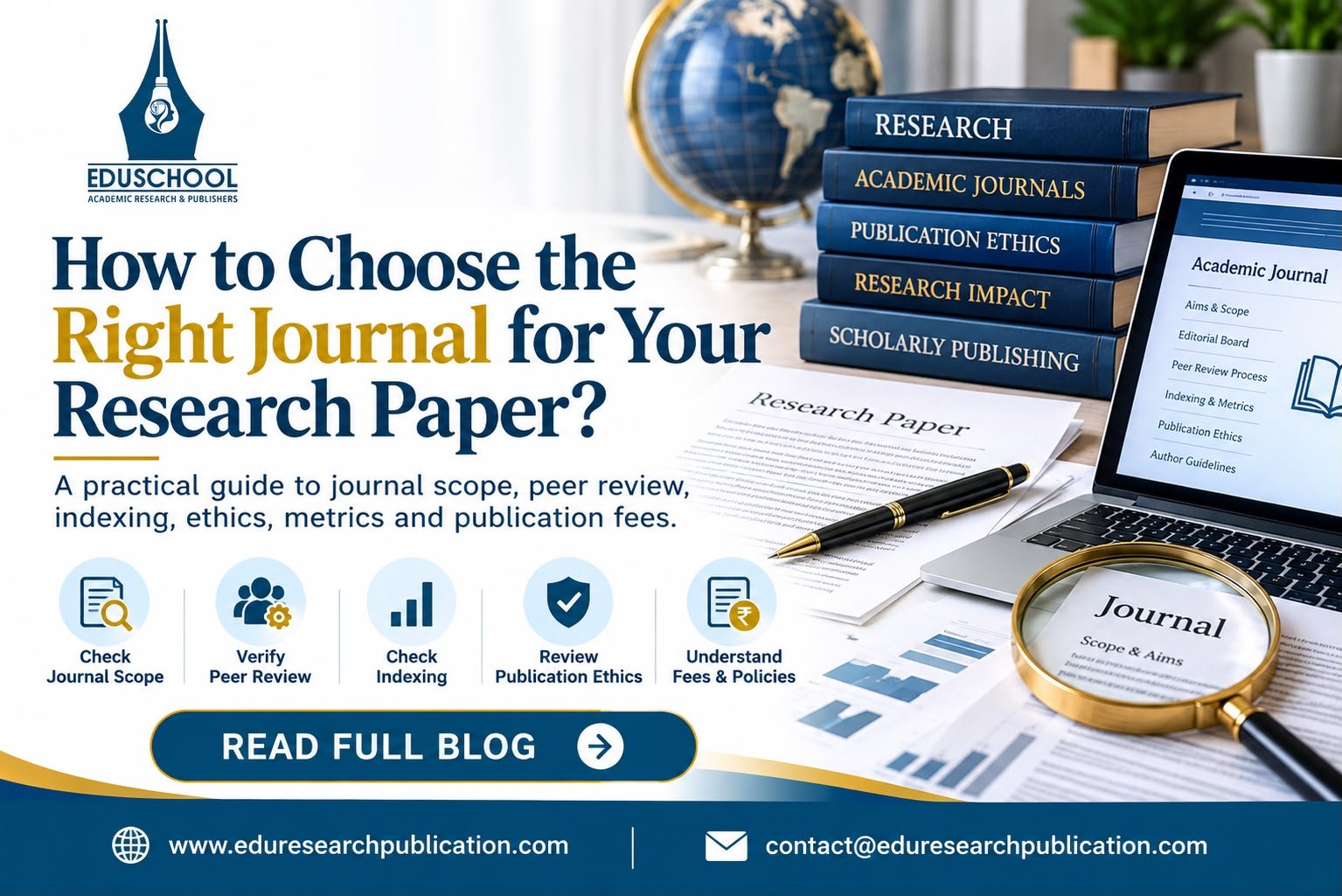
HOW TO CHOOSE THE RIGHT JOURNAL FOR YOUR RESEARCH PAPER?
Introduction
Completing a research paper is a significant achievement. But for many researchers, another important question comes immediately after manuscript preparation:
“Which journal should I submit my research paper to?”
Choosing a journal is not simply about finding a publication that accepts manuscripts. The right journal should be relevant to the research topic, appropriate for the target readership, transparent about its editorial and peer-review processes, and suitable for the researcher’s publication objectives.
A carefully selected journal can help a research paper reach the right academic audience. On the other hand, submitting to an unsuitable or unreliable journal can result in unnecessary rejection, delays, unexpected costs or concerns about publication credibility.
For PhD scholars, faculty members, research students and independent researchers, journal selection should therefore be treated as an important part of the research publication strategy.
This guide explains how researchers can evaluate a journal systematically before submitting their manuscript.
1. Start with Your Research Paper — Not the Journal
One of the most common mistakes researchers make is choosing a journal before understanding the positioning of their own research paper.
Before searching for journals, clearly identify:
- Your research disciplines
- Main research problem
- Research objectives
- Methodology
- Key findings
- Theoretical contribution
- Practical contribution
- Target academic audience
- Geographic or contextual focus
For example, a study examining artificial intelligence adoption among university faculty could potentially fit within education, educational technology, information systems, management or higher-education research.
However, the best journal depends on the actual research question, methodology, theoretical framework and intended readership.
Therefore:
First understand your research. Then identify the journals that regularly publish research similar to yours.
2. Check the Journal’s Scope
The first major criterion should be journal scope.
A journal’s scope describes the subjects, disciplines and research areas it intends to publish.
Before submitting, carefully read:
- Aims and scope
- Subject areas
- Article types
- Recent publications
- Special issues
- Target readership
Ask yourself:
Does my research genuinely belong in this journal?
For example, a paper focused primarily on higher-education pedagogy may not be appropriate for a highly specialized engineering journal simply because the journal has a large readership.
A strong scope match can improve:
- Editorial relevance
- Reviewer selection
- Reader interest
- Research discoverability
- Publication suitability
Scope should therefore be one of the first things you evaluate.
3. Study Recently Published Articles
The journal’s recent articles can tell you a great deal about its actual publication focus.
Do not rely only on the journal’s “Aims and Scope” page.
Read several recently published papers and examine:
- Research topics
- Methodologies
- Article length
- Research designs
- Theoretical frameworks
- Citation patterns
- Writing style
Ask:
Would my article look academically natural alongside these papers?
If the answer is yes, the journal may be a potentially suitable candidate.
4. Identify the Journal’s Target Audience
A research article should reach the people who can benefit from it.
Consider whether the journal’s readers are:
- Researchers
- Faculty members
- Engineers
- Medical professionals
- Economists
- Management scholars
- Social scientists
- Education researchers
- Industry professionals
A technically excellent paper may have limited impact if it is published in a journal whose audience has little interest in the subject.
Journal selection should therefore consider both academic fit and audience fit.
5. Examine the Peer-Review Process
A credible scholarly journal should provide clear information about its peer-review process.
Look for information explaining:
- Whether manuscripts are peer reviewed
- How reviewers are selected
- Whether the review is single-blind, double-blind or another model
- How editorial decisions are made
- What happens after revision
- How conflicts of interest are handled
A transparent peer-review policy is an important trust signal.
Researchers should be cautious when a journal makes extraordinary promises such as guaranteed acceptance or unrealistically short review and publication timelines.
6. Check the Editorial Board
The editorial board can provide useful information about a journal’s academic orientation.
Check whether the journal clearly identifies:
- Editor-in-Chief
- Associate or section editors
- Editorial board members
- Institutional affiliations
7. Verify Journal Indexing Claims
Indexing is one of the areas where researchers need to be especially careful.
A journal may claim to be indexed in databases such as:
- Scopus
- Web of Science
- DOAJ
- PubMed
- EBSCO
- ProQuest
- Other subject-specific databases
However, a logo displayed on a journal website is not sufficient proof of indexing.
Researchers should verify important indexing claims directly through the relevant database or official source.
This is particularly important when a journal claims to be:
- Scopus indexed
- Web of Science indexed
- SCI/SCIE indexed
- SSCI indexed
- AHCI indexed
Always distinguish between a genuine current indexing status and a marketing claim.
8. Understand Journal Metrics
Researchers often encounter several journal metrics during journal selection.
Examples include:
- Journal Impact Factor
- CiteScore
- SCImago Journal Rank (SJR)
- Journal Citation Indicator (JCI)
- Source Normalized Impact per Paper (SNIP)
These metrics have different meanings and should not be treated as interchangeable. A journal’s metric should also be checked using the appropriate official or recognized source.
Researchers should avoid selecting a journal solely because a website displays a high-sounding “impact factor” without verifying what the metric actually represents.
9. Understand Q1, Q2, Q3 and Q4
Researchers frequently ask:
“Should I publish in a Q1 journal?”
Quartiles are used in various journal-ranking systems to categorize journals within subject areas.
Broadly:
- Q1 — highest quartile
- Q2 — second quartile
- Q3 — third quartile
- Q4 — fourth quartile
However, quartile status can vary depending on:
- Database
- Subject category
- Ranking methodology
- Year
Therefore, researchers should always verify the database, category and year associated with a quartile claim.
10. Check Publication Frequency
Look at the journal’s stated publication frequency.
It may publish:
- Monthly
- Bimonthly
- Quarterly
- Biannually
- Annually
- Continuously
Publication frequency alone does not determine journal quality.
A monthly journal is not automatically better than a quarterly journal.
What matters more is whether the publication schedule is credible, consistently maintained and appropriate for the journal’s editorial capacity.
11. Check Article Processing Charges and Other Fees
Some journals charge an Article Processing Charge (APC), while others do not.
Before submission, determine:
- Whether an APC exists
- The exact amount
- When the fee is charged
- Whether taxes apply
- Whether discounts or waivers are available
- Whether other editorial or publication fees exist
Fee information should be transparent. Researchers should be particularly cautious when important charges appear only after acceptance.
12. Open Access vs Subscription
Journal selection may also involve choosing between different publishing models.
Open Access
Readers can generally access published articles without a subscription barrier, subject to the journal’s licensing model.
Subscription
Access may primarily be provided through institutional or individual subscriptions.
Hybrid
Some subscription journals provide open-access options for individual articles. The best model depends on the researcher’s objectives, funding arrangements, institutional requirements and desired readership. Open access does not automatically mean higher quality, and subscription publishing does not automatically mean lower quality.
13. Check Publication Ethics
Before submission, examine the journal’s policies on:
- Plagiarism
- Retractions
- Corrections
- Conflicts of interest
- Duplicate submission
- Data integrity
- Human and animal research ethics
A credible journal should communicate its publication ethics policies clearly. Researchers should also understand their own responsibilities as authors.
14. Watch for Predatory Journal Warning Signs
Researchers should be alert to journals that demonstrate multiple warning signs.
Potential concerns include:
- Guaranteed publication
- Guaranteed acceptance
- Extremely short peer-review promises
- Unclear editorial board
- Fake or unverifiable indexing claims
- Poor-quality website
- Hidden fees
- Aggressive unsolicited emails
- Excessive emphasis on payment
- Fake metrics
- Unclear publisher identity
- Lack of transparent peer-review information
One warning sign alone does not necessarily prove that a journal is predatory. However, multiple unexplained warning signs should trigger further investigation.
15. Check the Journal’s ISSN
An ISSN identifies a continuing publication such as a journal.
A journal may have separate identifiers for:
- Print edition
- Online edition
Researchers should verify that the journal’s ISSN information is consistent across its website and recognized ISSN records where applicable. However, having an ISSN does not by itself establish journal quality or indexing status. This is an important distinction for early-career researchers.
16. Examine the Publisher
Find out who publishes the journal.
Check:
- Publisher name
- Publisher address
- Contact information
- Journal portfolio
- Editorial policies
- Publication history
- Transparency of ownership and operations
A credible journal should make its publisher identity reasonably clear. Researchers should be cautious when the publisher’s identity is difficult to establish.
17. Check the Journal’s Publication History
Look at previous volumes and issues.
Ask:
- Does the journal have a consistent publication history?
- Are previous issues accessible?
- Are article metadata complete?
- Are DOI details available where applicable?
- Are publication dates clear?
- Are previous articles discoverable?
A journal with a consistent publication record provides useful evidence about its operational continuity.
18. Check DOI Information
A Digital Object Identifier (DOI) provides a persistent identifier for a digital scholarly object.
If a journal assigns DOIs, researchers should verify that the DOI information resolves correctly and corresponds to the published article. However, the presence of a DOI should not be interpreted as proof that a journal is indexed in Scopus or Web of Science. Each claim should be independently verified.
19. Consider the Journal’s International Reach
For researchers seeking international visibility, it may be useful to examine:
- Geographic diversity of authors
- Editorial board diversity
- International readership
- International collaborations
- Subject coverage
- Language of publication
However, internationalization should be evaluated meaningfully rather than simply by counting countries listed on a website.
20. Check Author Guidelines Before Submission
Before submitting your paper, carefully read the journal’s author instructions.
Look for:
- Word limit
- Abstract requirements
- Keyword requirements
- Reference style
- Figure specifications
- Table requirements
- Manuscript structure
- File format
- Ethical declarations
- Author contribution statements
- Data availability statements
- Conflict-of-interest declarations
Failure to follow author guidelines can create unnecessary editorial problems.
21. Create a Journal Shortlist
Instead of choosing the first journal you find, create a shortlist.
A practical approach is to identify approximately 5–10 potentially suitable journals and compare them.
For each journal, record:
Criterion | Journal A | Journal B | Journal C |
|---|---|---|---|
Scope match | ✓ | ✓ | ✓ |
Peer review | ✓ | ✓ | ? |
Indexing verified | ✓ | ? | ✓ |
APC transparent | ✓ | ✓ | ? |
Editorial board | ✓ | ✓ | ✓ |
Ethics policy | ✓ | ✓ | ? |
Recent relevant articles | ✓ | ✓ | ✓ |
Publication model | OA | Hybrid | Subscription |
This simple comparison can make journal selection much more systematic.
22. Never Choose a Journal Solely Because It Is Fast
Fast publication can be attractive, particularly when researchers have academic deadlines. However, speed should not replace quality assessment.
Ask:
Why is the journal able to publish so quickly?
Is the stated timeline realistic?
Does the journal explain its editorial and peer-review workflow?
Is there evidence that manuscripts actually undergo meaningful review?
A credible publication process should prioritize scholarly quality and integrity.
23. The Right Journal Is About Fit
There is no single “best journal” for every researcher.
The best journal for a particular paper is generally the journal that provides an appropriate combination of:
Research Fit + Audience Fit + Quality + Transparency + Ethical Standards + Appropriate Visibility
A highly ranked journal that is poorly aligned with your research may be less suitable than a well-established journal with a stronger subject fit.
24. Final Journal Selection Checklist
Before clicking Submit, ask yourself:
Research Fit
☐ Does the journal publish my research area?
☐ Have I read recent relevant papers?
☐ Does my research contribute to the journal’s audience?
Quality
☐ Is the peer-review process clearly explained?
☐ Is the editorial board transparent?
☐ Does the journal have a credible publication history?
Indexing
☐ Have I independently verified important indexing claims?
☐ Have I checked the relevant database directly?
Ethics
☐ Does the journal have clear publication ethics policies?
☐ Are authorship and conflict-of-interest policies available?
Financial
☐ Are APCs and other fees clearly disclosed?
☐ Do I understand when payment is required?
Submission
☐ Have I followed the author guidelines?
☐ Is my manuscript ready for submission?
If you can answer these questions confidently, you are in a much stronger position to select an appropriate journal.
Conclusion
Choosing the right journal is an important decision in the research publication journey. Researchers should avoid selecting journals based solely on promises of fast publication, attractive metrics or impressive-looking indexing logos. Instead, evaluate the journal systematically.
Start with scope and research fit. Examine recent publications. Understand the target readership. Evaluate peer review and editorial policies. Verify indexing claims through appropriate sources. Check publication ethics, fees, journal metrics and author guidelines.
Most importantly, remember:
The right journal is not necessarily the journal with the biggest name. It is the journal that is the right scholarly home for your research.
A thoughtful journal-selection process can save researchers time, reduce avoidable rejection and help their work reach the academic audience for which it was intended.
