


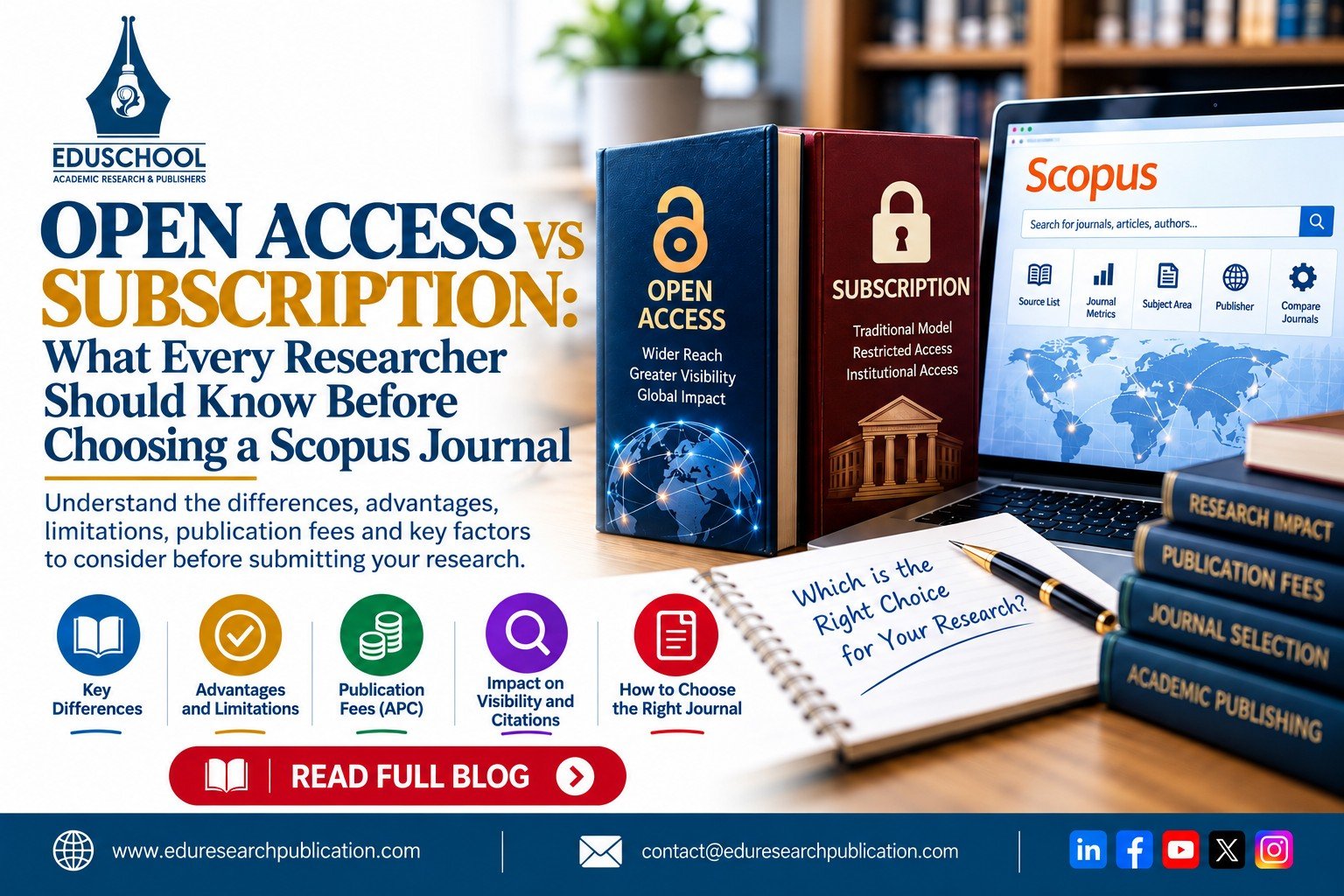
Open Access vs Subscription: What Every Researcher Should Know Before Choosing a Scopus Journal
Introduction
Choosing the right academic journal is one of the most important decisions in the research publication process. In addition to evaluating journal scope, indexing, peer review, and editorial quality, researchers must understand how the journal makes its published articles available to readers.
Two common publishing models are open access and subscription-based publishing. Each has different implications for accessibility, publication costs, copyright, readership, and research dissemination.
For PhD scholars, faculty members, and researchers aiming to publish in reputable journals, understanding these differences can help them make informed decisions.
An important point must be clarified at the beginning: Scopus indexing and a journal’s publishing model are separate matters. A journal may be covered by Scopus and operate under an open-access, subscription, or hybrid model. Researchers should verify both the journal’s current indexing status and its publishing policies independently.
This guide explains the differences between open access and subscription publishing, their advantages and limitations, and the factors to consider before submitting your manuscript.
1. What is Open Access Publishing?
Open access (OA) publishing makes scholarly articles available online without requiring readers to pay a subscription or purchase the individual article.
Depending on the licence, readers may also be permitted to share, reuse, or adapt the published work under specified conditions.
The primary objective of open access is to make research more accessible to the global academic community and other interested readers.
Common characteristics of open access
- Articles are freely accessible online.
- Readers generally do not need a subscription to read the full text.
- Research can reach readers beyond well-funded institutions.
- Reuse permissions depend on the applicable licence.
- Some journals charge authors an article processing charge (APC), while others do not.
Important: Open access does not automatically mean that authors must pay to publish. Some journals operate without author-facing publication charges, while others charge APCs or offer different funding arrangements.
Types of open access
Gold open access: The final published article is immediately available openly on the journal’s platform. An APC may apply, but not every gold OA journal charge one.
Green open access: Authors make an eligible version of their work available through an institutional repository or another permitted repository, subject to the publisher’s policy.
Diamond or platinum open access: Articles are freely available to readers and authors are not charged publication fees, with costs supported by other funding arrangements.
Hybrid open access: A subscription journal allows authors to make individual articles openly accessible, often by paying an APC.
These models differ in their costs, licences, and access conditions. Researchers should examine the specific journal and publisher policies before submitting.
2. What Is Subscription-Based Publishing?
In subscription-based publishing, access to the full text of journal articles is generally provided through subscriptions purchased by individuals, libraries, universities, or other institutions.
Some articles may also be available for individual purchase. Authors may be able to share certain versions of their papers through repositories or other permitted channels, depending on the publisher’s policy.
Common characteristics of subscription publishing
- Full-text access may require a subscription or payment.
- Universities and research institutions may provide access through their libraries.
- Publication costs and author charges vary by journal.
- Authors may have options for sharing accepted manuscripts under specific conditions.
- Some subscription journals offer a hybrid open-access option.
A subscription model does not automatically indicate poor accessibility or lower research quality. Many established scholarly journals operate under subscription or hybrid arrangements.
Likewise, a journal’s subscription model does not guarantee quality. Editorial standards, peer review, research integrity, and relevance must still be evaluated.
3. Open Access vs Subscription: Key Differences
Parameter | Open access | Subscription-based |
|---|---|---|
| Reader access | Full text is generally freely available | Full text may require payment or institutional access |
| Author publication fees | May apply, but not always | Vary; some journals charge certain fees |
| Research visibility | Removes reader paywalls for the open article | Access may depend on institutional subscriptions |
| Copyright | Depends on publisher agreement and licence | Depends on publisher agreement |
| Reuse rights | Defined by the applicable open licence | Often more restricted, subject to policy |
| Funding options | APC funding, waivers, institutional support, or no-fee models | Depends on the journal and publishing agreement |
| Repository sharing | Depends on the licence and policy | Often possible for specified versions under stated conditions |
| Peer review | Depends on the journal’s editorial process | Depends on the journal’s editorial process |
The most important lesson is that access model, publication cost, and research quality are three different considerations.
4. Advantages of Open Access Publishing
4.1 Wider reader access
Open access removes the subscription barrier for readers accessing the published article. Researchers at institutions without extensive library subscriptions may be able to read and use the findings more easily.
4.2 Greater potential for research dissemination
Because the article is freely accessible, it can be shared more easily with researchers, practitioners, policymakers, educators, and the public.
However, open access does not guarantee higher citation counts or greater academic impact. Citation outcomes depend on many factors, including research quality, relevance, field, discoverability, and time since publication.
4.3 Support for global research collaboration
Free access can make it easier for researchers in different countries and institutions to consult the same evidence, helping to support collaboration and knowledge exchange.
4.4 Potential for broader societal use
Research findings may be more readily available to professionals, independent researchers, teachers, and organizations that do not have access to subscription databases.
4.5 Alignment with funder requirements
Some funders and institutions require research outputs to be made openly accessible. Authors should check applicable policies before choosing a journal and before signing a publishing agreement.
5. Limitations of Open Access Publishing
Open access has important advantages, but researchers should also consider its limitations.
Article processing charges: Some journals charge substantial APCs. Authors should confirm the full cost before submission and investigate waivers, institutional agreements, and funding options.
Predatory publishing risks: Some publishers exploit the open-access model by making misleading claims or providing inadequate peer review. Open access itself is not the problem; deceptive or poor-quality publishing practices are.
Licence considerations: Creative Commons and other licences can grant different reuse permissions. Authors should understand how their work may be shared, adapted, or used commercially.
Funding constraints: Authors without institutional support may find APC-funded journals difficult to afford. No-fee open-access options may be worth exploring.
A responsible decision requires evaluating the journal’s credibility, fees, policies, and suitability—not merely its access label.
6. Advantages and Limitations of Subscription Publishing
Subscription journals can offer credible editorial processes and established scholarly readerships. Institutional subscriptions may also give researchers access to large collections of academic literature.
However, subscription publishing has limitations.
- Readers without subscriptions may face paywalls.
- Individual article purchases can be expensive.
- Access may vary across institutions and countries.
- Authors must review the publisher’s manuscript-sharing rules.
- Some funder policies may require additional open-access arrangements.
Researchers should not assume that subscription journals are always cheaper for authors or that all subscription articles are inaccessible to non-subscribers. Journal-specific policies matter.
7. Does Open Access Improve Citations and Research Impact?
This is a common question among PhD scholars and faculty members.
Open access can make an article available to a broader group of readers, which may increase opportunities for discovery and use. However, the relationship between open access and citations varies across disciplines and studies.
Citation counts can also be affected by:
- Research topic and relevance
- Journal readership
- Article quality
- Publication year
- Research community size
- Collaboration networks
- Discoverability and promotion
- Citation practices within the field
Therefore, do not select an open-access journal solely because you expect more citations.
Choose the journal that best fits the research, maintains credible standards, and meets your access and funding requirements.
8. Does Scopus Indexing Depend on the Publishing Model?
No. Open access and subscription publishing describe how articles are made available. Scopus coverage is a separate database-selection and indexing matter.
A journal may be:
- Open access and covered by Scopus
- Subscription-based and covered by Scopus
- Hybrid and covered by Scopus
- Open access but not covered by Scopus
- Subscription-based but not covered by Scopus
These are possible combinations; the status of any specific journal must be verified independently.
Before submission, search the official Scopus Sources database and check the journal’s exact title, ISSN, publisher, and current coverage information.
Do not assume that a journal is indexed simply because its website displays a Scopus logo.
9. How to Choose the Right Publishing Model
Before making a decision, consider the following questions.
Research relevance
Does the journal publish work similar to yours? Is your manuscript appropriate for its audience?
Indexing requirements
Does your university, institution, or funding body require coverage in a particular database? Verify the current requirements and the journal’s status.
Publication budget
Can you afford the APC, if any? Are waivers, grants, or institutional agreements available?
Accessibility goals
Do you want readers outside subscribing institutions to access the full text without payment?
Copyright and licensing
Are you comfortable with the publisher’s copyright agreement and the permitted reuse of your article?
Funding policies
Does your funder require immediate open access or a particular licence? Could the journal’s embargo or sharing conditions conflict with those requirements?
Editorial quality
Does the journal provide transparent peer review, clear ethics policies, and credible editorial information?
The best choice is the one that balances these considerations while maintaining research quality and publication integrity.
10. A Practical Checklist Before Choosing a Scopus Journal
Use this checklist before submitting your research paper.
- Verify the journal’s current Scopus coverage.
- Confirm that the journal’s scope matches your manuscript.
- Identify whether the journal is open access, subscription-based, or hybrid.
- Check the APC and any additional charges.
- Review available waivers and institutional funding.
- Examine the copyright and licence terms.
- Check repository-sharing permissions.
- Confirm compliance with funder and institutional policies.
- Review the journal’s peer-review and publication ethics policies.
- Ensure the publication model meets your research dissemination goals.
Conclusion: Choose Access Strategically and Publish Responsibly
Open access and subscription publishing offer different ways of distributing scholarly research. Open access provides free reader access to the published article, while subscription publishing may place full-text access behind a payment or institutional subscription.
Neither model automatically determines a journal’s quality, indexing status, or academic value.
For researchers, the right decision depends on research relevance, editorial credibility, publication costs, licensing, funder requirements, and intended readership.
Before submitting to a Scopus journal, verify its current indexing status and carefully review its publishing model.
The golden rule: Choose the journal for its research fit and credibility, understand the cost and access conditions, and make an informed publication decision.
Frequently Asked Questions
1. Is open access better than subscription publishing?
Neither is universally better. Open access provides free reader access, while subscription publishing uses subscription-based access. The right model depends on your goals, budget, and requirements.
2. Do all open-access journals charge APCs?
No. Some charge APCs, while others provide open access without author publication fees.
3. Are all Scopus-indexed journals open access?
No. Scopus-covered journals can operate under open-access, subscription, or hybrid models.
4. Does open access guarantee more citations?
No. Open access can increase the opportunity for readers to access an article, but citations depend on many factors.
5. Can I publish open access in a subscription journal?
Some subscription journals offer a hybrid option in which authors can pay to make an individual article openly accessible. Check the journal’s current policies and fees.
6. How can I verify a Scopus journal?
Search the exact journal title or ISSN in the official Scopus Sources database and examine the current coverage details.
