


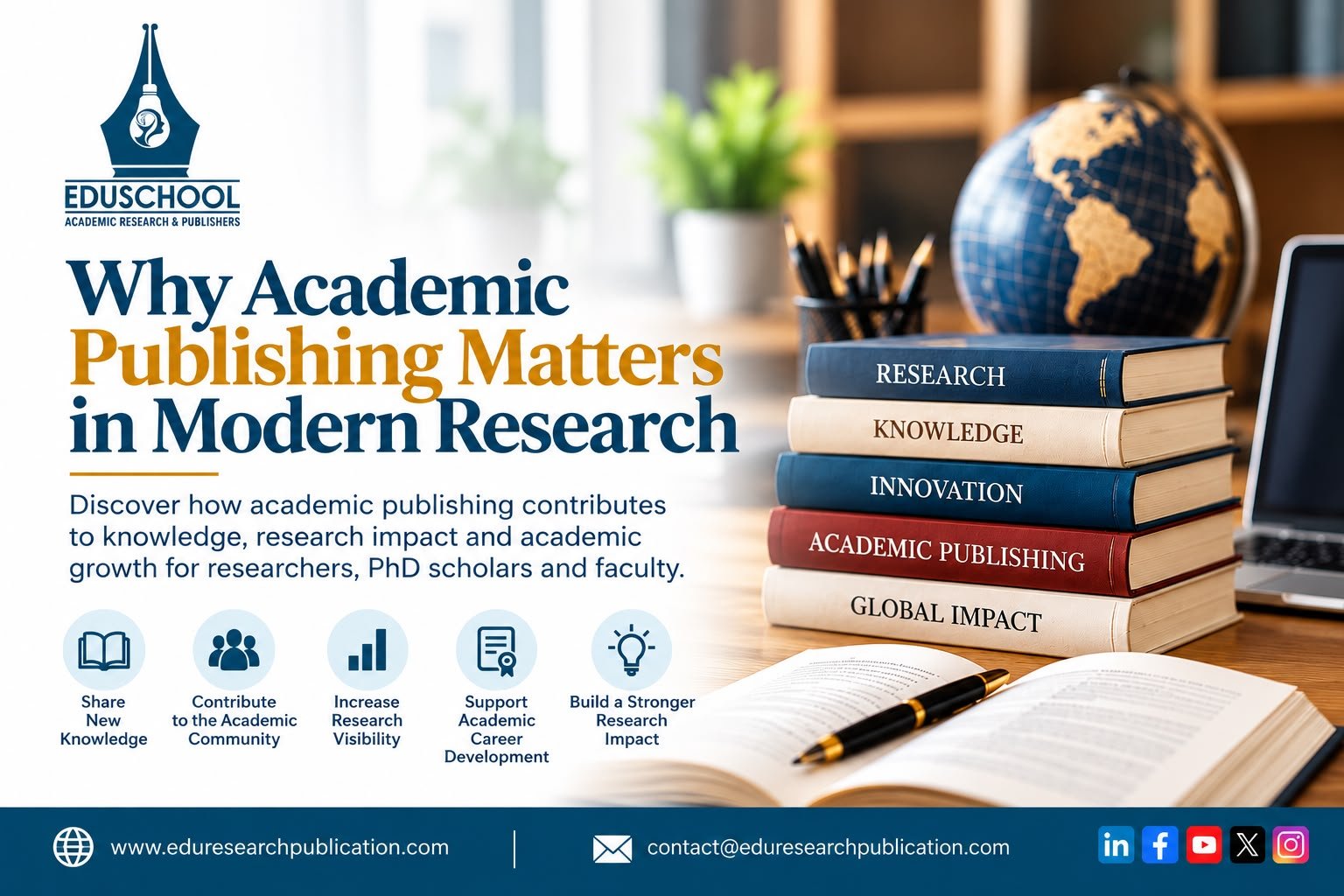
WHY ACADEMIC PUBLISHING MATTERS IN MODERN RESEARCH
Research is one of the most important ways through which new knowledge is created, tested, evaluated and shared. However, completing a research project is not necessarily the end of the research journey. For research to contribute meaningfully to academia and society, its findings need to be communicated to the wider scholarly community.
This is where academic publishing plays a fundamental role.
Academic publishing provides a structured mechanism through which researchers can communicate their findings, methodologies, theories, observations and conclusions to other scholars, institutions, professionals and, in many cases, the wider public.
A well-written research paper published through an appropriate scholarly journal can become part of the permanent academic record. It can be discovered by other researchers, cited in subsequent studies, discussed in academic communities and used as a foundation for future research.
For PhD scholars, faculty members, research supervisors and academic professionals, publication can therefore be an important component of a broader research career. However, publication should not be viewed simply as a requirement for obtaining a degree, promotion or institutional recognition.
The deeper purpose of academic publishing is to contribute reliable knowledge to a particular field of study.
This article explains why academic publishing matters, how the scholarly publication process works, what researchers should consider before submitting a manuscript, and how responsible publishing can contribute to long-term research impact.
1. What Is Academic Publishing?
Academic publishing refers to the process of communicating scholarly research through recognized academic channels such as research journals, conference proceedings, academic books, edited volumes and other scholarly publications.
A typical research publication may contain:
- A clearly defined research problem
- Research objectives or questions
- A review of relevant literature
- An appropriate research methodology
- Data collection and analysis
- Findings
- Discussion
- Conclusions
- References
- Information about limitations and future research
Academic journals provide one of the most important platforms for communicating this work.
Unlike general publishing, scholarly publishing normally involves established editorial and review procedures designed to evaluate the quality, relevance and originality of submitted manuscripts.
2. Why Should Researchers Publish Their Work?
There are several important reasons why researchers publish.
2.1 Sharing New Knowledge
The fundamental purpose of research publication is knowledge sharing.
A researcher may discover a new relationship between variables, develop a theoretical perspective, identify a previously unexplored problem, test an existing theory or produce evidence from a particular population or geographical context.
Publishing makes these findings accessible to other researchers.
Without effective dissemination, even valuable research may remain relatively unknown.
2.2 Contributing to the Academic Community
Research is cumulative.
Researchers build on previous studies and in turn, provide foundations for future researchers.
A published article may:
- Confirm previous findings
- Challenge existing assumptions
- Introduce new evidence
- Identify new research questions
- Propose a new conceptual framework
- Provide evidence from a new geographical or demographic context
- Suggest practical applications
In this way, academic publishing contributes to the continuing development of knowledge.
3. Academic Publishing and the Research Cycle
Research should not be understood as a single activity.
A simplified research cycle can be represented as:
Research Problem → Literature Review → Research Design → Data Collection → Analysis → Findings → Publication → Dissemination → Further Research
Publication occupies an important position within this cycle.
Once research findings are published, other scholars can examine them, replicate the study, challenge the conclusions or extend the research.
This creates an ongoing scholarly conversation.
4. The Role of Peer Review
One of the important features of scholarly publishing is peer review.
In a peer-reviewed journal, a submitted manuscript is evaluated according to the journal's editorial and review procedures. Depending on the journal, reviewers may examine areas such as:
- Originality
- Research problem
- Literature review
- Methodology
- Data analysis
- Interpretation
- Quality of references
- Clarity of presentation
- Ethical considerations
- Contribution to the field
Some journals use double-blind peer review, where the identities of authors and reviewers are concealed from one another during the review process.
Peer review does not mean that a published article is automatically free from every possible error. Rather, it is an important quality-control mechanism within scholarly communication.
Researchers should therefore understand the review process before submitting their work.
5. Academic Publishing Builds Research Visibility
Publishing research can increase the visibility of a researcher's work.
A discoverable article can potentially be found through:
- Academic search engines
- Journal websites
- Institutional repositories
- Research databases
- Library systems
- Scholarly indexing services
Visibility becomes particularly important when researchers want their work to reach scholars beyond their immediate institution.
However, visibility should always follow quality.
Researchers should not focus exclusively on increasing the number of publications. A stronger long-term approach is to produce research that is original, methodologically sound, ethically conducted and relevant to the field.
6. Publication and Academic Career Development
Academic publishing can form part of a researcher's professional development.
For faculty members and researchers, scholarly publications may contribute to:
- Building an academic profile
- Demonstrating research activity
- Developing subject expertise
- Establishing collaborations
- Supporting applications for academic opportunities
- Increasing scholarly visibility
- Developing a citation record
- Contributing to institutional research output
Requirements for academic appointments, promotions, degrees and institutional evaluation vary by country, institution and applicable regulations.
Therefore, researchers should always consult the current requirements of the relevant university, institution or regulatory body rather than assuming that every publication has the same academic value.
7. Why Journal Selection Matters
Publishing a research paper is not simply a matter of finding any journal that accepts manuscripts.
The journal should be appropriate for the research.
Before submission, researchers should examine:
Scope
Does the journal publish research in your subject area?
Article Types
Does it accept original research articles, review papers, case studies or other relevant formats?
Peer-Review Policy
Is the review procedure clearly explained?
Editorial Information
Are the editor and editorial board details transparent and verifiable?
Publication Ethics
Does the journal provide clear information about research and publication ethics?
Indexing Claims
Are claims regarding indexing and databases verifiable through the relevant official sources?
Publication Model
Is the journal open access, subscription-based or operating under another model?
Fees
Are article processing charges or other publication fees clearly disclosed?
A carefully selected journal can improve the relevance and discoverability of the research while reducing the risk of submitting to an unsuitable publication.
8. Academic Publishing and Research Ethics
Responsible academic publishing requires strong ethical standards.
Researchers should pay particular attention to:
- Plagiarism
- Fabrication of data
- Falsification of results
- Duplicate publication
- Unethical authorship
- Undisclosed conflicts of interest
- Manipulation of citations
- Misrepresentation of research findings
Researchers should also ensure that appropriate ethical approvals, participant consent and data-protection procedures are followed wherever applicable.
Academic integrity is not merely a requirement of journals. It is a fundamental responsibility of researchers.
9. Quality Is More Important Than Publication Quantity
A common mistake among early-career researchers is to focus only on the number of papers published.
A stronger approach is to ask:
Does this research make a meaningful contribution?
A high-quality publication should ideally demonstrate:
- A clearly defined research problem
- A meaningful research gap
- Appropriate methodology
- Reliable evidence
- Logical analysis
- Clear presentation
- Appropriate references
- Ethical research practices
- A meaningful contribution
Ten weak publications do not necessarily provide greater scholarly value than a smaller number of carefully conducted studies.
Researchers should therefore think about research quality, relevance and contribution rather than publication quantity alone.
10. From Publication to Research Impact
Publication is only one stage of scholarly communication.
After publication, researchers can responsibly increase the visibility of their work by:
- Sharing the article through appropriate academic networks
- Maintaining an accurate ORCID profile
- Updating institutional research profiles
- Presenting findings at appropriate academic events
- Engaging with researchers working in the same field
- Depositing permissible versions in institutional repositories
- Developing follow-up studies
- Collaborating with other researchers
Researchers should always follow the copyright, licensing and sharing policies applicable to the journal and publisher.
Research impact develops over time.
11. Common Mistakes Researchers Should Avoid
Mistake 1: Choosing a journal only because it promises fast publication
Speed should not be the primary criterion for journal selection.
Mistake 2: Assuming that every indexed journal has the same academic value
Different databases, journal metrics and indexing services have different purposes and standards.
Mistake 3: Submitting without reading the author guidelines
Formatting, reference style, word limits and manuscript structure vary between journals.
Mistake 4: Ignoring plagiarism and citation practices
Poor citation practices can create serious academic-integrity problems.
Mistake 5: Making unsupported claims
Researchers should distinguish clearly between their findings, interpretations and established evidence.
Mistake 6: Treating publication as the final objective
Publication is better understood as part of the continuing research communication process.
12. A Practical Pre-Submission Checklist
Before submitting a manuscript, researchers can ask:
Research
- Is the research problem clearly defined?
- Is the research gap adequately established?
- Are the objectives clear?
- Is the methodology appropriate?
Manuscript
- Is the abstract accurate?
- Are the keywords relevant?
- Are tables and figures properly labelled?
- Is the discussion connected to the findings?
- Are limitations acknowledged?
References
- Are important recent studies included?
- Are citations accurate?
- Is the required referencing style followed?
Journal
- Does the journal's scope match the manuscript?
- Is the peer-review process clearly described?
- Are publication policies transparent?
- Are fees clearly disclosed?
- Are indexing claims independently verifiable?
Ethics
- Has plagiarism been checked?
- Are all authors appropriately acknowledged?
- Are conflicts of interest disclosed?
- Are ethical approvals and participant-consent requirements addressed where applicable?
13. The Bigger Purpose of Academic Publishing
At its best, academic publishing creates a bridge between research and knowledge.
A researcher's work does not exist in isolation. Every credible study becomes part of a larger scholarly conversation.
One researcher asks a question.
Another researcher investigates it.
A third researcher challenges the findings.
A fourth researcher extends the study into a new context.
Over time, these individual contributions help develop the knowledge base of an academic discipline.
That is why responsible academic publishing matters.
The objective should not simply be to produce another publication.
The objective should be to communicate research responsibly, contribute meaningful knowledge and create a foundation for future scholarship.
Final Thoughts
Academic publishing is an essential component of the modern research ecosystem.
It allows researchers to communicate findings, participate in scholarly discussions, develop academic visibility and contribute to the advancement of knowledge.
For PhD scholars, faculty members, research supervisors and academic professionals, understanding the publication process is therefore as important as understanding research methodology itself.
Researchers should approach publication strategically: identify a meaningful research problem, conduct rigorous research, prepare a well-structured manuscript, select an appropriate journal, follow ethical standards and communicate findings accurately.
Most importantly, researchers should remember that quality research should always come before publication quantity.
A strong publication is not merely a line on an academic CV. It is a contribution to the scholarly record.
